
Commercial Tree Surgery RAMS UK
Commercial tree surgery RAMS need to do more than satisfy a checklist — they need to show that the work has been properly planned, risk assessed and structured for the specific site, client and task.
This guide covers what commercial RAMS for tree surgery must include, how they differ from domestic paperwork, the hazards they need to address, and why generic templates consistently fall short on commercial sites.
What are commercial tree surgery RAMS?
RAMS stands for Risk Assessment and Method Statement. In commercial tree surgery, RAMS are the primary safety document submitted to a client, principal contractor or local authority before work begins. They explain the hazards involved in the tree work, the control measures in place, and the step-by-step method that will be followed on site.
Commercial tree surgery RAMS are more detailed and specific than basic domestic paperwork. They need to demonstrate that the work has been genuinely planned for the specific site, that the risks have been properly assessed, and that the controls in place are realistic and practical — not just listed for appearance. For councils, schools, housing developments, principal contractors, estates and facilities management companies, professional RAMS are a non-negotiable requirement before any arborist is granted site access.
What commercial tree surgery RAMS must include
A complete commercial RAMS pack for tree surgery brings together several types of documentation. Each element serves a specific purpose and together they form the coherent submission that commercial clients expect.
Core RAMS documents
- Hazard-based risk assessment with initial and residual risk ratings
- Step-by-step method statement following the actual work sequence
- Site-specific information — location, access, nearby hazards
- Emergency arrangements including nearest A&E location
- Operator competence and qualification references
- Equipment to be used and pre-use check confirmation
- COSHH information — fuel, oil, substances used on site
Supporting records (commercial sites)
- Daily site briefing records
- Exclusion zone check records
- Equipment pre-use check sheets
- Near miss and incident reporting records
- Training and competence logs
- Equipment inspection and maintenance records
- COSHH assessments as standalone documents
Tree surgery hazards that commercial RAMS must address
Commercial RAMS should reflect the actual hazards involved in arboricultural work on real commercial sites. These fall across several categories — people, equipment, environment and the specific tasks being carried out. Each hazard should be linked to clear, realistic control measures in the risk assessment and reflected in the method statement.
Chainsaw operations
Ground-based and aerial chainsaw use — kickback, contact injury, noise, vibration and PPE requirements for all operators.
Climbing and aerial work
Working at height — SRS and MRS climbing systems, equipment inspection, rescue planning and competence requirements.
MEWP operations
Mobile elevated work platforms — operator competence, ground conditions, overhead hazards, outrigger placement and exclusion zones.
Rigging and dismantling
Sectional dismantling using rigging systems — load calculations, anchor point assessment, lowering controls and ground crew management.
Falling timber and debris
Controlled and uncontrolled falling of branches, sections and debris — exclusion zones, dropped object controls and public protection.
Wood chipper operations
Entanglement, ejection, noise and vibration — operator training, PPE, exclusion zones and pre-use inspection records.
Stump grinding
Ejected material, buried services, dust and vibration — site investigation, exclusion zones and PPE requirements for operators and bystanders.
Public interface
Members of the public, pedestrians, vehicles and site users — exclusion zone establishment, signage, banksmen and site access control throughout the operation.
Noise, vibration and dust
HAVS from chainsaw and stump grinder use, respiratory risks from wood dust and chainsaw exhaust — PPE, exposure monitoring and rotation management.
What commercial tree surgery RAMS look like in practice
The ArbDesk RAMS system is structured specifically for commercial submissions — clear hazard identification, realistic control measures, step-by-step method statements and supporting records all built around how commercial tree work is actually reviewed by contractors and councils.
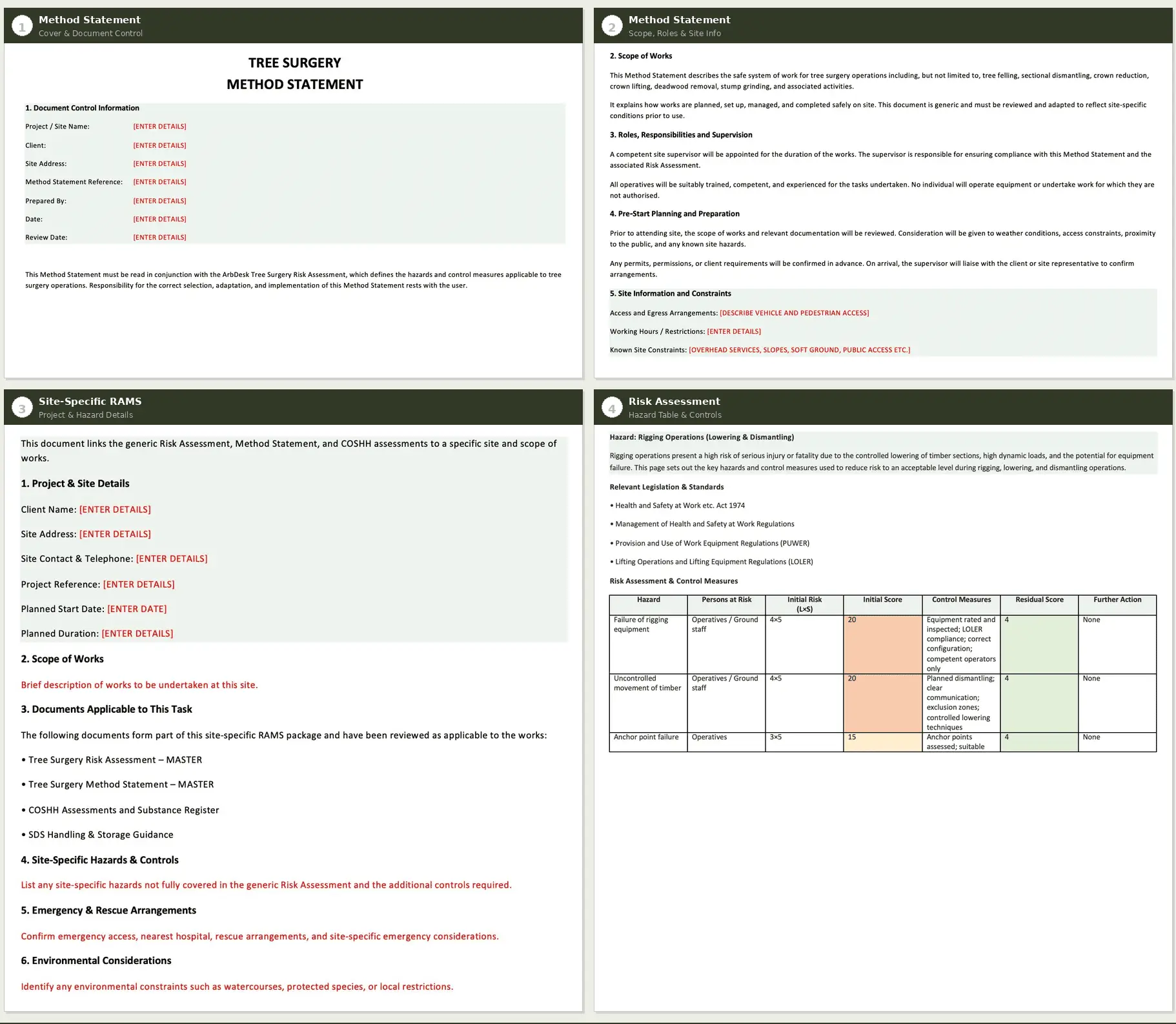
ArbDesk commercial tree surgery RAMS — structured for UK principal contractor and local authority submissions.
How commercial tree surgery RAMS differ from domestic paperwork
The difference between domestic and commercial RAMS is not just about length — it is about depth, specificity and the questions the documents need to answer. A document that satisfies a private client will often be immediately rejected by a principal contractor or council.
Domestic tree work
- Basic hazard list often sufficient
- Generic method description usually accepted
- Site-specific detail rarely expected
- Emergency planning informal
- Supporting records rarely requested
- Competence rarely formally verified
Commercial tree work
- Hazard-based risk scoring with residual risk required
- Step-by-step method statement for this specific site
- Site-specific information mandatory for every submission
- A&E location, rescue plan and first aid formally required
- COSHH, equipment records and briefing sheets expected
- Qualification copies and competence declarations required
The legislation behind commercial tree surgery RAMS
Commercial RAMS for tree surgery are not just a contractual formality — they are how arborists demonstrate legal compliance with their duty to manage health and safety at work. The following legislation directly applies to commercial tree surgery operations in the UK:
Requires suitable and sufficient risk assessments for all work activities. The risk assessment element of commercial RAMS must satisfy this duty — a generic hazard list does not meet the “suitable and sufficient” standard.
Applies on construction-type sites. Principal contractors must receive method statement documentation before subcontractors begin work. CDM is the formal basis for the RAMS submission requirement on many commercial sites.
Requires all work equipment to be suitable, maintained and operated by competent persons. Commercial RAMS must reflect PUWER compliance — pre-use checks, maintenance records and operator competence must be addressed.
Requires assessment of substances hazardous to health. Chainsaw fuel, bar oil and wood dust must be assessed. Commercial clients increasingly expect COSHH assessments as part of the RAMS submission rather than as separate documents.
All climbing and aerial operations must be planned, supervised and carried out by competent persons. The method statement must describe how aerial access is managed and how a rescue would be carried out if required.
Arboriculture and Forestry Advisory Group guidance sets the industry standard for safe tree work. Commercial clients use AFAG-aligned systems as the benchmark for assessing whether a contractor’s RAMS reflect genuine competence.
Written by a practising arborist
ArbDesk was built by Christian, a working arborist with direct experience submitting RAMS to principal contractors, councils and commercial clients across the UK. The commercial RAMS system in ArbDesk is not based on generic H&S templates — it reflects what actually gets submitted on real UK commercial sites, what causes rejections, and what gets accepted first time.
The hazard coverage, document structure and supporting records in ArbDesk are based on real submission experience — including council tree contracts, principal contractor sites, schools, housing developments and estate management work — not on what the legislation technically requires in isolation.
“Proper system built around how arborist work actually runs. Not just a generic template.”
Commercial tree surgery RAMS — frequently asked questions
Built for arborists working commercially
ArbDesk gives you a complete commercial tree surgery RAMS system — risk assessments, method statements, COSHH, equipment records and operational safety documents built around what UK commercial clients and principal contractors actually expect to see.
Instant access · No app · No subscription · Fully editable documents
You may also find these useful