
Arborist RAMS Framework (UK)
A structured approach to RAMS for arborists working on UK commercial sites — built around what contractors, councils and principal contractors actually expect to see.
This guide explains how a professional arborist RAMS framework should be structured, what it must include, and why generic templates consistently fall short on real commercial work.
More than a set of documents
An arborist RAMS framework is the structured system used to present risk assessments and method statements for tree work. Rather than creating documents from scratch every time a commercial job comes in, a proper framework gives you a consistent structure that can be adapted quickly to each site, task and client.
For commercial work, this structure is not just useful — it is essential. RAMS documents are reviewed by site managers, principal contractors and health and safety advisors before any work begins. A framework that is unclear, incomplete or poorly structured causes delays, resubmissions and in some cases lost contracts.
Core components of a commercial arborist RAMS system:
- Hazard-based risk assessments for key tree work operations
- Step-by-step method statements following the work sequence
- Site-specific information for every job
- COSHH assessments for substances used on site
- Equipment pre-use check records (PUWER)
- Site safety briefing records
- Near miss and incident reporting
- Competence declarations and operator qualifications
- Emergency arrangements and local A&E details
Core components of a commercial arborist RAMS framework
A complete RAMS framework for UK commercial tree work brings together four types of documentation. Each serves a distinct purpose and together they form the coherent submission that commercial clients and principal contractors expect.
Risk assessments
Hazard-based assessments covering the key activities in commercial tree work. Each hazard should include persons at risk, initial risk rating, control measures and residual risk after controls are applied.
- Chainsaw use — ground and aerial
- Climbing operations and rigging
- Machinery — chipper, stump grinder
- Manual handling and exclusion zones
- Public interface and site access
Method statements
Method statements explain how the work will actually be carried out in practice. For arboriculture, this should follow the real sequence of operations on site — not a generic description of tree work in general.
- Site setup, access and exclusion zones
- Equipment checks before work begins
- Climbing or MEWP access method
- Cutting, lowering and rigging techniques
- Site clearance and completion
Site-specific information
Every job requires site-specific information that turns a generic RAMS into a usable, job-specific document. This is the section most commonly missing or insufficiently completed in generic templates.
- Location, access arrangements and hazards
- Nearby roads, buildings and utilities
- Public safety and weather considerations
- Emergency access and nearest A&E
- Client or site-specific requirements
Supporting safety records
On commercial sites, RAMS documents are rarely accepted in isolation. Supporting records demonstrate that safety is being managed in practice — not just written down.
- COSHH assessments
- Equipment pre-use check sheets
- Site safety briefing records
- Near miss and incident reports
- Competence declarations
What a professional arborist RAMS system looks like
The ArbDesk RAMS system is structured for quick review by contractors and principal contractors — clear hazard identification, risk scoring, method statements and supporting records all built around how commercial tree work is actually carried out on site.
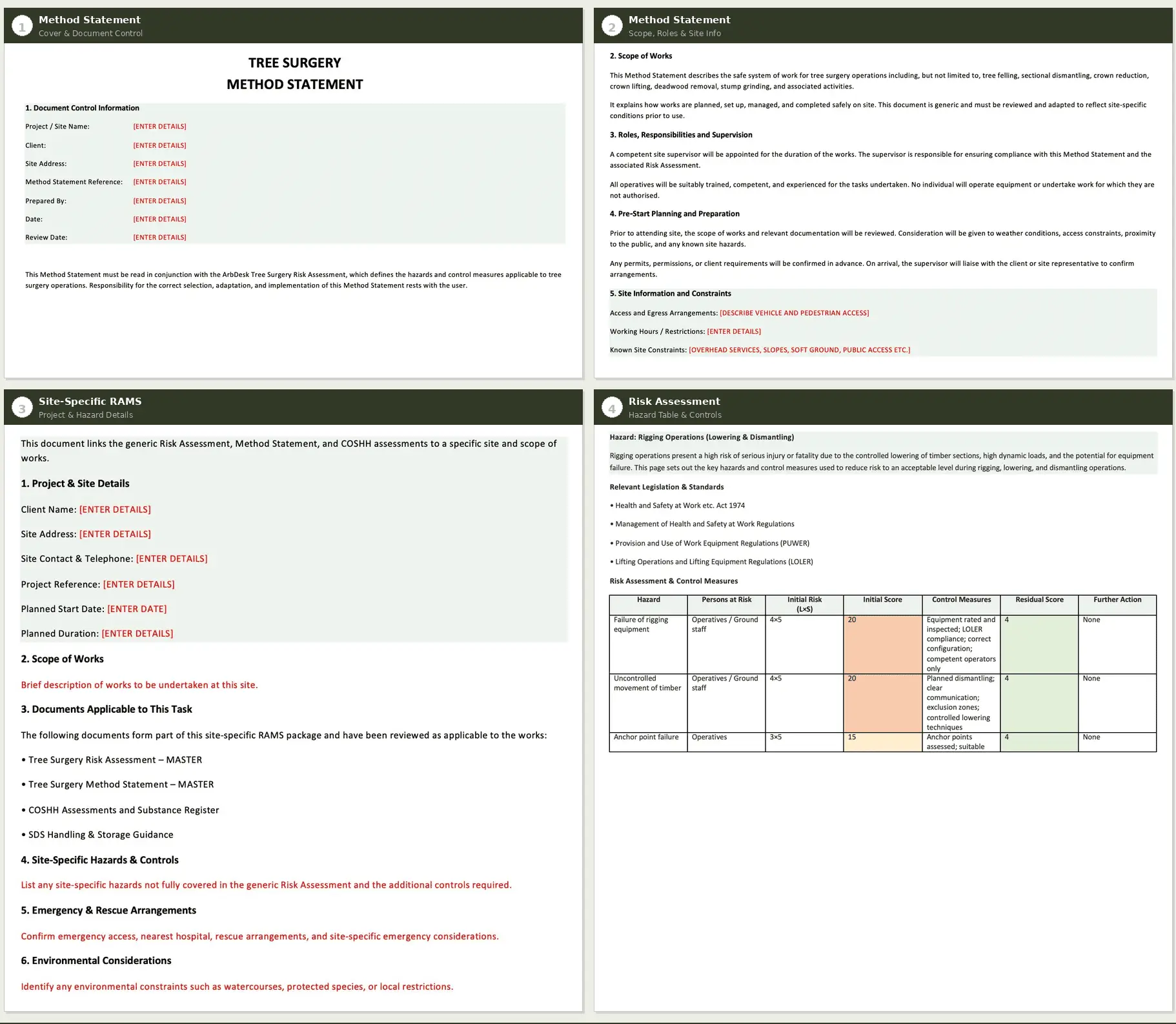
ArbDesk RAMS system — structured for UK commercial tree work and designed for fast contractor review.
Why generic RAMS templates consistently fall short
Most generic RAMS templates look reasonable at first glance. They cover the basic hazards, describe the work in broad terms and give the appearance of a completed document. On a domestic job or a straightforward private site, they may pass without question. On commercial work — council contracts, principal contractor sites, schools, estates — they consistently cause problems.
Too generic to be credible
A RAMS that reads identically for every job signals that it has not been considered for this job. Commercial reviewers spot this immediately.
Hazards without proper controls
Listing hazards is only half the requirement. Generic templates often fail to link each hazard to meaningful, site-specific control measures with a clear risk rating.
Vague method statements
Steps like “carry out tree work” or “ensure site safety” don’t describe anything. Method statements must follow the actual sequence of operations on the specific site.
Missing supporting documents
Commercial clients increasingly expect COSHH assessments, equipment pre-use checks and site briefing records alongside RAMS. Templates rarely address this.
No site-specific detail
Generic templates leave site-specific sections blank or minimal. Emergency arrangements, access routes and local hazards must be completed for every job.
No legislative framework
Commercial clients expect RAMS to reference the relevant legislation and guidance — PUWER, Management of H&S Regs, AFAG, CDM. Generic templates rarely do this.
The legislation behind arborist RAMS
RAMS documents are not just a contractual formality — they are how arborists demonstrate legal compliance with their duty to manage health and safety at work. For UK commercial tree work, a properly structured RAMS framework needs to reflect the following legislation and guidance:
Requires employers and the self-employed to carry out suitable and sufficient risk assessments. For commercial arborists, this means assessing all significant hazards associated with the work — not just chainsaw use.
Applies when arborists work as subcontractors on construction-type sites. Principal contractors require RAMS submissions before work can begin under CDM — the framework must meet this standard.
Requires that all work equipment including chainsaws, chippers and stump grinders is suitable, maintained and operated by trained, competent persons. Pre-use checks form part of PUWER compliance.
Requires assessment of substances hazardous to health used in the work — including chainsaw fuel and bar oil, wood dust, and any pesticides or herbicides applied on site.
All climbing and aerial operations must be properly planned, supervised and carried out by competent persons. The RAMS framework should reflect how aerial access is controlled throughout the job.
Arboriculture and Forestry Advisory Group guidance sets out best practice for tree work operations. Commercial clients expect RAMS to align with AFAG safe systems of work — it is the industry standard.
Written by a practising arborist
The ArbDesk RAMS framework was built by Christian, a working arborist with direct experience submitting RAMS to principal contractors, local authorities and commercial clients across the UK. The system is not based on generic H&S templates — it is built around what actually gets reviewed on commercial sites and what causes documents to be sent back.
After years of rebuilding RAMS from scratch for every commercial job, and watching colleagues lose contracts or face resubmissions over poorly structured paperwork, the ArbDesk system was developed to solve the problem properly — with a framework that reflects how commercial tree work actually runs on site.
Every document in the system has been used on real UK commercial sites, including council tree work, principal contractor submissions and estate management contracts.
“Proper system built around how arborist work actually runs. Not just a generic template.”
How arborist RAMS are actually used on commercial sites
Understanding how RAMS are reviewed on commercial sites changes how you approach them. In most cases, the person reviewing your submission is not an arborist — they are a site manager, a principal contractor’s H&S coordinator, or a local authority procurement officer. They are looking at the documents quickly and checking specific things.
Can they understand the work?
The method statement must explain clearly what will happen on site — from arrival to completion — in terms a non-arborist can follow.
Are the key risks identified?
Chainsaw use, public exclusion, overhead lines, machinery — reviewers scan for the hazards they expect to see. If they are missing, the submission fails immediately.
Are the controls realistic?
Control measures that are vague or generic — “ensure safety at all times” — are flagged immediately. Controls must be specific to the task and the site.
Is emergency planning in place?
Local A&E location, first aid arrangements, rescue plan for a climber — these are almost universally checked. Missing these causes instant rejection.
Arborist RAMS — frequently asked questions
See how a professional arborist RAMS framework is structured
Download the free sample to see the document layout before committing. The ArbDesk system includes structured RAMS, supporting safety records and editable Word documents — built by a practising arborist for UK commercial tree work.
Instant access · No app · No subscription · Fully editable documents
You may also find these useful