
Arborist Method Statement Example (UK)
A method statement explains how tree work will be carried out safely, step by step. For commercial jobs, it is often the most scrutinised part of your RAMS — and the part most likely to cause a rejection if it is too vague.
This guide covers what a method statement should include, how it should be structured for UK commercial tree work, and why generic examples fall short on real sites.
More than a task description
A method statement is a structured document that explains how work will be carried out in practice. For arborists, it sits alongside the risk assessment within a RAMS submission and describes the actual sequence of operations — from site arrival through to completion and sign-off.
Where a risk assessment identifies hazards and control measures, the method statement explains the practical steps. Together they demonstrate that the work has been properly planned and the risks genuinely managed — which is what commercial clients and principal contractors need to see before approving access.
A professional arborist method statement should cover:
- Description of the work to be carried out
- Site setup, access and exclusion zones
- Equipment to be used and pre-use checks
- Sequence of tree work operations
- Climbing or MEWP access method
- Ground operations and public interface
- Waste removal and site clearance
- Emergency arrangements and first aid
- Competence of operatives
- Link to risk assessment and site-specific controls
What an arborist method statement looks like
The following shows the structure and level of detail expected for UK commercial tree work. This is a simplified example — a full commercial method statement would include site-specific detail, equipment references, operator competence confirmation, and emergency planning throughout.
Arrival and site sign-in
Operatives arrive on site, report to the client or site contact, sign in and review the RAMS document before work begins. Any site-specific inductions are completed at this stage.
Site setup and exclusion zones
Establish the work area. Set up exclusion zones using barriers, cones and signage appropriate to the site. Position vehicles and equipment to allow safe access and egress. Confirm communication method between climber and ground crew.
Equipment pre-use checks
All equipment is inspected before use in line with PUWER requirements. Chainsaw, PPE, climbing equipment, rigging hardware and any machinery (chipper, stump grinder) are checked and recorded on the pre-use check sheet.
Access to tree
Climber ascends using approved climbing techniques (SRS or MRS) or MEWP where required. Equipment is set as per manufacturer guidance and the climbing system checked before weight is applied.
Tree work operations
Carry out pruning, dismantling or felling using appropriate techniques for the species, structure and site conditions. Sections and branches are lowered under control using rigging where required. Ground crew manage the exclusion zone and process arisings.
Ground operations and chipper use
Ground operatives process arisings through the chipper in line with PUWER pre-use check requirements. Logs are stacked or removed as agreed with the client. The exclusion zone is maintained throughout.
Site clearance and completion
All arisings are processed or removed. Signage and barriers are taken down. The site is left safe, tidy and in the agreed condition. A final check is carried out and the client or site contact is notified of completion.
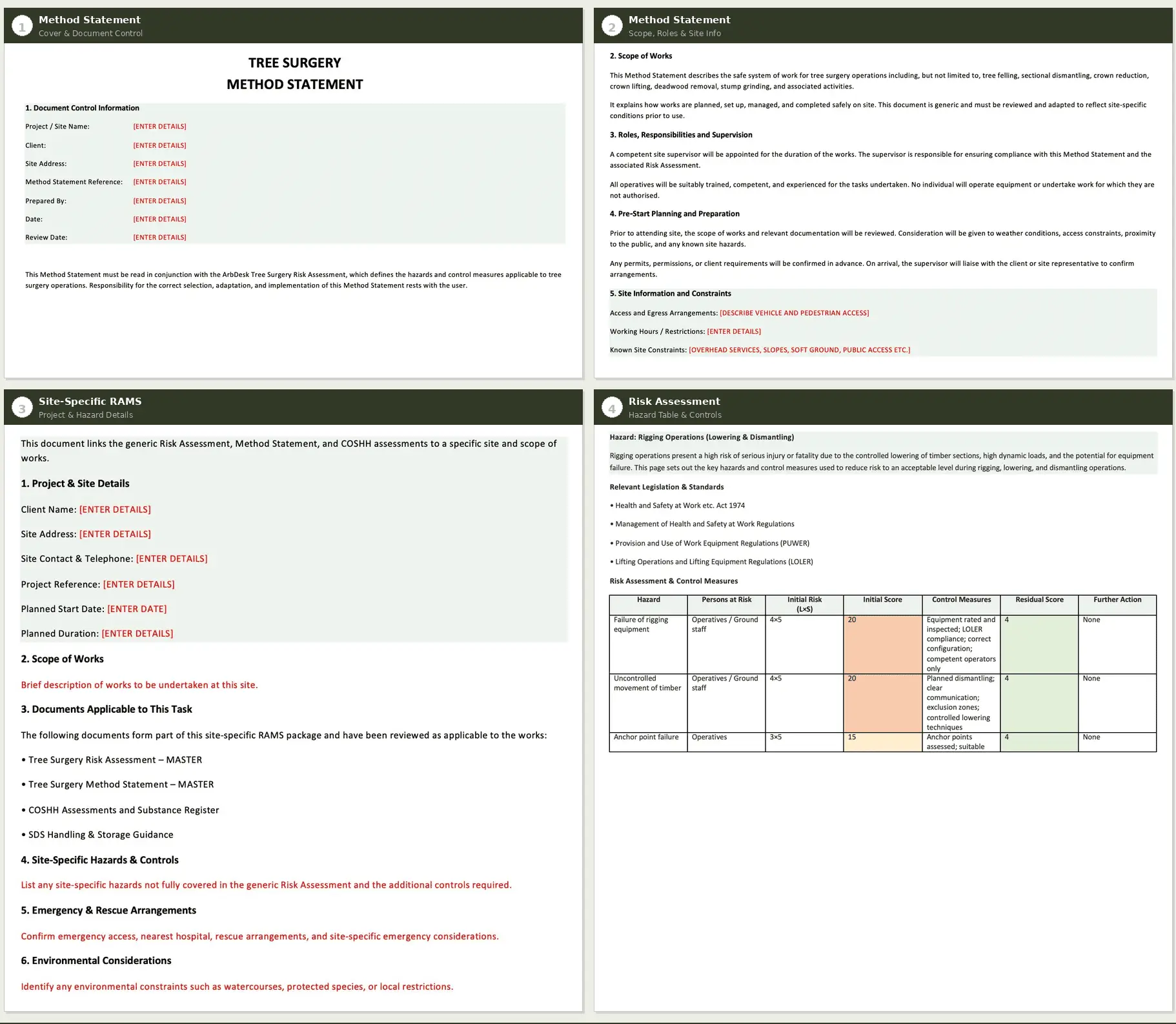
Example of structured arborist RAMS documentation from the ArbDesk system, used on UK commercial tree work.
Written by a practising arborist
The ArbDesk method statement system was built by Christian, a working arborist with direct experience submitting RAMS to principal contractors, local authorities, and commercial clients across the UK.
The method statement structure in ArbDesk reflects how commercial tree work is actually carried out and reviewed — not how a generic H&S template assumes it works. After spending years watching colleagues lose contracts or face resubmissions because their method statements were too vague or poorly sequenced, the ArbDesk system was built to solve the problem properly.
The step-by-step format is based on what principal contractors and site managers actually need to see to approve access — and is adapted from documents used on real UK commercial sites.
“Proper system built around how arborist work actually runs. Not just a generic template.”
Is a method statement a legal requirement?
A standalone method statement is not always a legal requirement in isolation — but the duty to plan and manage work safely, which a method statement helps satisfy, is. For commercial tree work in the UK, method statements are almost always required contractually by clients and principal contractors, and they form part of the broader legal framework that arborists must work within.
The relevant legislation and guidance that method statements help to satisfy includes:
Requires that work is planned and managed so risks are controlled. A method statement demonstrates that planning has taken place and the work sequence has been considered.
On construction-type sites, principal contractors require RAMS from subcontractors before work starts. A method statement is a standard part of that submission.
Requires that work equipment is used safely by competent operators. A method statement should reference equipment use and link to pre-use checks.
Arboriculture and Forestry Advisory Group guidance informs best practice for tree work operations. Method statements should reflect AFAG-aligned safe systems of work.
Climbing operations must be planned, supervised and carried out by competent persons. The method statement should reflect how aerial access is managed safely.
HSE guidance on arboricultural operations and chainsaw use sets out expected safe systems of work that should be reflected throughout the method statement.
Why generic method statement examples get rejected
Many free method statement examples look reasonable at first glance. They describe broadly what tree work involves, list a few steps, and cover the basics. On a domestic job or a straightforward site, they may be accepted. On commercial work — council contracts, principal contractor sites, schools, estates — they consistently fall short.
Too vague to be useful
Steps like “carry out tree work” or “ensure site is safe” don’t explain anything. Commercial reviewers want to understand the actual sequence of operations.
Not linked to risk controls
A method statement should refer back to the control measures in the risk assessment. Generic examples rarely do this, leaving a gap between the two documents.
No equipment references
Commercial sites expect to see how equipment will be used and how pre-use checks are carried out. Generic examples rarely mention specific equipment or PUWER obligations.
Missing emergency planning
How a rescue would be carried out, where the nearest A&E is, and what the communication method is between climber and ground crew — often completely absent from generic examples.
No competence references
Principal contractors want to know that the people carrying out the work are qualified. Method statements should reference operator competence, not assume it is implied.
Doesn’t match the actual job
A method statement cut and pasted from a previous job, without adapting it for the site and task, reads as exactly that. Reviewers notice immediately.
How the method statement connects to the rest of your RAMS
A method statement does not stand alone. For commercial tree work, it forms one part of a wider RAMS submission that typically includes several interconnected documents. Understanding how they connect is what separates a professional submission from a collection of documents that happen to be in the same folder.
Risk assessment
Identifies the hazards, the people at risk, the controls and the residual risk. The method statement explains how those controls are applied in practice during the work sequence.
Site-specific assessment
Adapts the general risk controls to the actual site — its access, hazards, public interface and emergency arrangements. The method statement should reflect these site-specific details throughout.
COSHH assessment
Covers fuel, oil, chemicals and biological hazards. Where these are handled on site, the method statement should reference how they are managed as part of the work sequence.
Equipment pre-use checks
PUWER requires equipment to be checked before use. The method statement should reference this step explicitly rather than assuming it is understood.
Arborist method statement — frequently asked questions
Need a complete arborist RAMS system?
ArbDesk gives you a fully structured method statement and RAMS system built for UK commercial tree work — editable Word documents, used on real sites, built by a practising arborist.
Instant access · No app · No subscription · Fully editable documents
You may also find these useful