Arborist RAMS for UK Commercial Tree Work.
Built by Arborists,
for real site work.
Professional tree surgery RAMS, risk assessments and COSHH documentation for UK commercial and council work. Fully editable Word & PDF documents, instant download — no software, no subscriptions, no generic templates.
Created for use on real UK commercial sites - schools, councils, industrial estates. Download once and reuse job-to-job. Includes task-specific risk assessments (e.g. climbing, felling, chainsaw use) within a full commercial RAMS system.
Commercial clients don’t accept generic templates.
If your RAMS structure doesn’t meet expectations, documentation can be rejected or sent back for revision —
costing time and credibility.
ArbDesk is structured for real UK commercial submissions, so you’re not scrambling to fix paperwork at the last minute.
See the structure and formatting used in the ArbDesk Commercial RAMS System by downloading a sample.
Instant download — no spam.
Example extract from the ArbDesk Commercial RAMS System — structured for UK school, industrial and council site work.
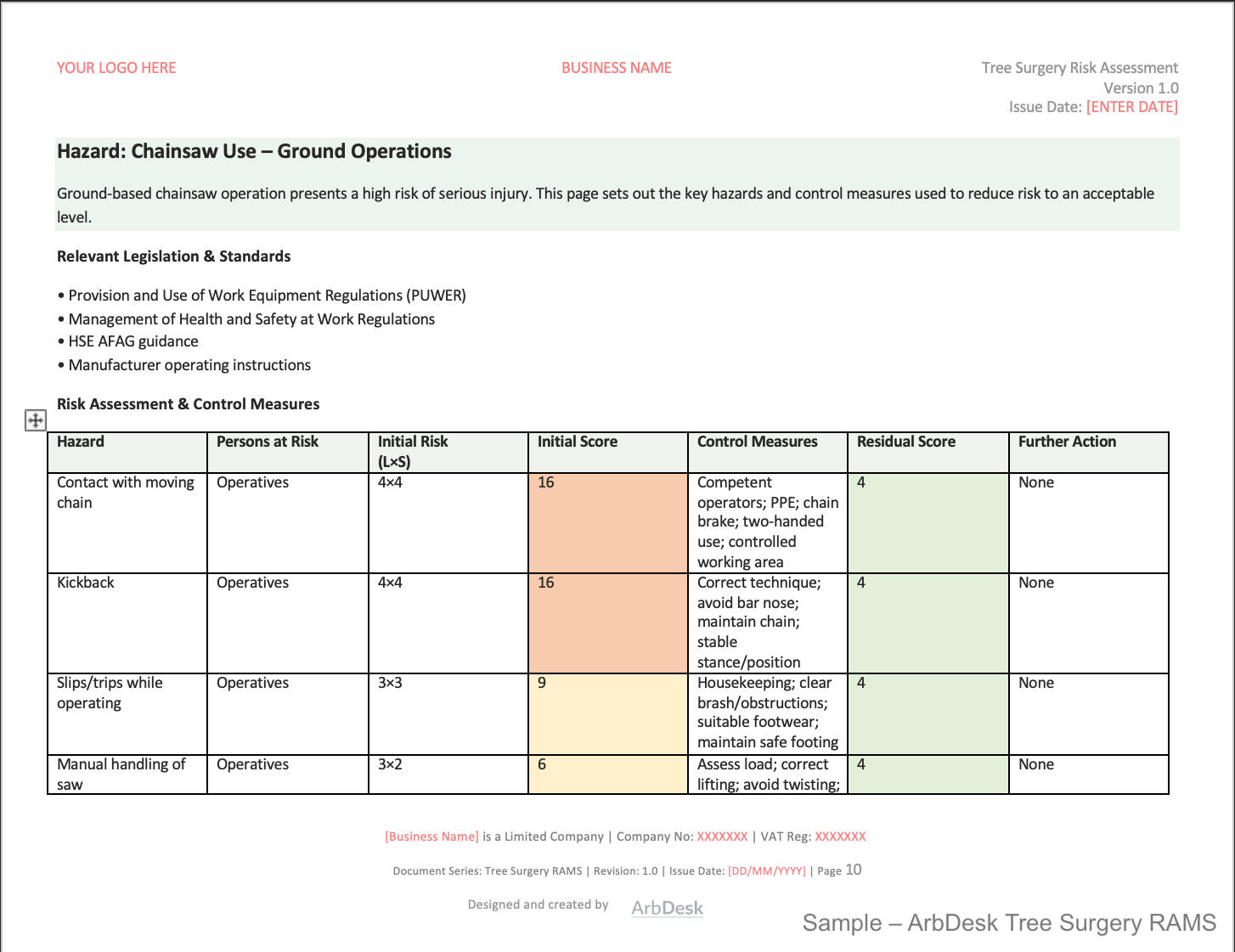
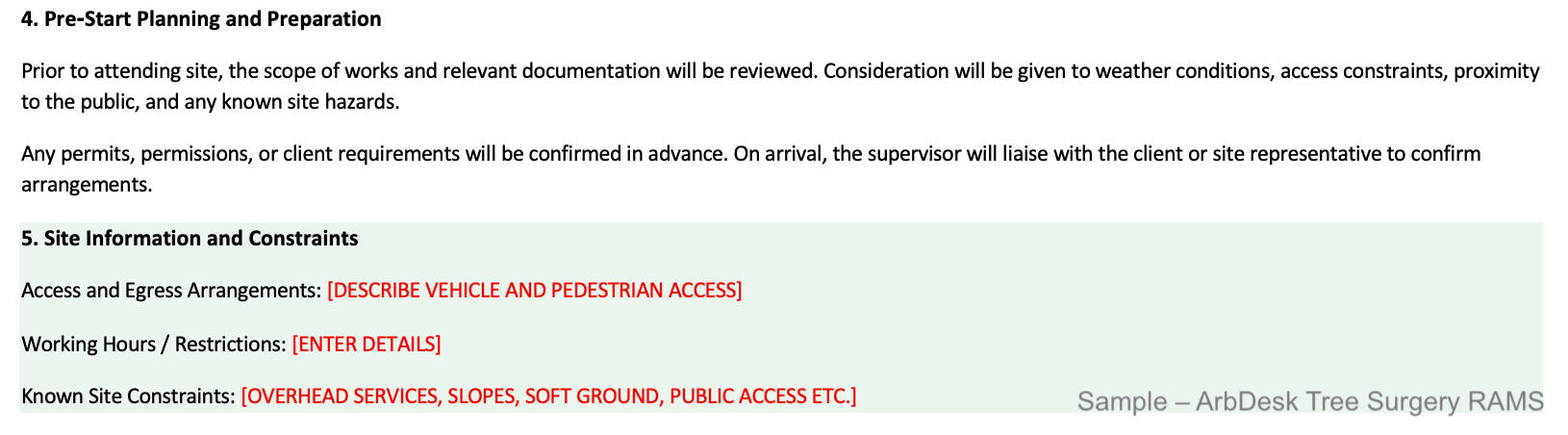
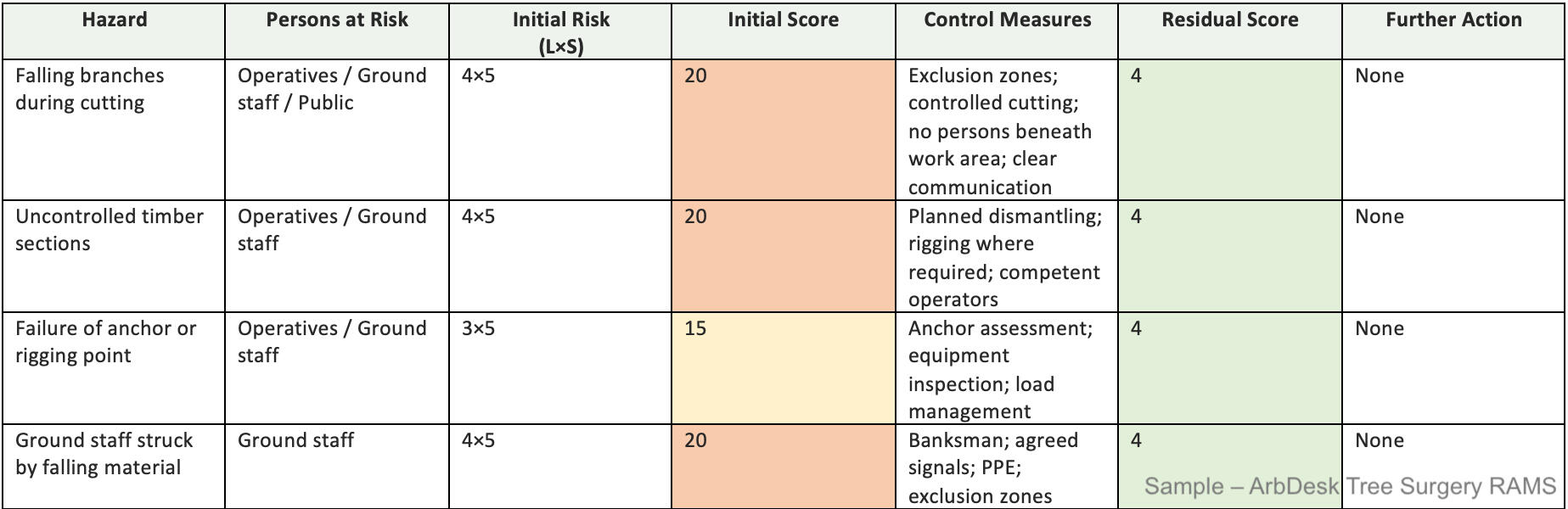
Fully editable Word documents. No subscriptions. Instant download.
Explaining Commercial RAMS Structure
Where ArbDesk Is Used
ArbDesk documents are used on real UK commercial sites and submitted to managing agents, councils and principal contractors. The system is designed for subcontractor RAMS submissions and routine commercial tree work — not surveys or consultancy reports.
ArbDesk is built and maintained by working UK arborists, with documents updated as real site requirements change.
What's Included (Starter Pack)-Tree Surgery RAMS (hazard-based, scored)
-Full Method Statement
-Site-specific RAMS cover sheet
-COSHH Management System
-Substance register + pre-filled COSHH
-Editable Word / Excel files
-Read-Me-First setup guide
Starter Pack £49 inc VAT · Instant download · Fully editable Word documents
Questions before buying? Email [email protected]
If ArbDesk isn’t right for your job, just email us and we’ll refund you.
Ready to use ArbDesk on a live job?
View the full document packs and download instantly.
What Is ArbDesk?ArbDesk is a set of professional compliance document systems built specifically for arborists.These are not generic health and safety templates. They are structured RAMS, COSHH and site paperwork designed from real arboricultural work, refined on live commercial and council jobs and intended to be reused and adapted job to job.
Built by Arborists — Not a software company.ArbDesk was created by working Arborists dealing with real commercial clients, principal contractors and council requirements.Every document in these packs exists because it was needed on site — not because a software platform decided it should.Digital-first. Not app-dependent.
ArbDesk systems are designed to be used digitally on tablets, phones, and laptops. Edit on site and submit as Word or PDF — no apps, logins, or subscriptions required.
Works seamlessly with iPad, Android tablets and cloud storage such as OneDrive, Google Drive and Teams.
What's Included in the ArbDesk System
-Structured Risk Assessment & Method Statement (RAMS) framework
-COSHH assessment framework aligned with arboricultural use
-Equipment pre-use check templates
-Site-specific sign-off sheets for crews and supervisors
-Commercial Documents (Quote sheets, Contract of Work, Invoices, statement of account etc)
-Clear folder structure ready for real jobs
-Fully editable Word documents
-Plain-language guidance written from an arborist’s point of view
Structured to match how principal contractors actually review RAMS.
The exact documents you receive depend on the pack selected. Full details below.
Starter Pack £49 Inc. VAT
Instant Download | No Subscription
Built and used by UK Arborists
✔ Used on real UK commercial and council jobs
✔ Fully editable Word documents — no locked files
✔ Instant download after checkoutIncludes:
• Tree Surgery RAMS system
• Site-specific commercial cover sheet
• COSHH management system
• Competence declaration
• Step-by-step setup guideTree Surgery RAMS Framework Covers
• Ground-based chainsaw operations
• Aerial chainsaw operations (climbing & MEWP)
• Rigging and sectional dismantling
• Falling timber and branches
• Wood chipper operations
• Stump grinder operations
• Manual handling
• Slips, trips and falls
• Driving and operating work vehicles
• Public interface and exclusion zonesThis structured framework allows arborists to produce professional RAMS documentation suitable for commercial and principal contractor work.
Commercial RAMS get rejected everyday
Missing details, Poor structure, No site specific cover.
This system was built to pass first time.
VAT invoice provided automatically. Digital product — instant access.
Pro Pack £89 Inc. VATIncludes:
Everything in the Starter Pack Plus
- Plant and equipment pre-use check Management System
Once you move into regular commercial work, pre-use equipment checks are expected. The Pro Pack gives you ready-made inspection records that tie directly into your RAMS, reducing admin, avoiding repeated requests and giving clear evidence that equipment checks are being managed properly on site.For arborists regularly submitting RAMS and COSHH for commercial clients and principal contractors.
Launching soon for growing commercial Arborists.
Upgrade friendly: If you purchase a higher pack later, you’ll only pay the difference — you’ll never be asked to buy the same documents twice.
Complete Business Pack £149 Inc. VATIncludes:
– Everything in the Starter and Pro Packs
– Professionally structured commercial document templates
– A practical credit control system for managing invoices and paymentsThe Complete Business Pack is built for arboricultural businesses planning to grow into regular commercial or managed-site work. Alongside full RAMS, COSHH and pre-use checks, it includes professionally structured commercial document templates and a practical credit control system — giving you control over both compliance and the commercial side of the business as work volume increases.Designed for businesses that want to be organised, compliant and commercially credible as they grow.
Available soon for established commercial operators.
built from live commercial arborist paperwork used on council and principal-contractor sites.
Frequently Asked QuestionsAre these documents accepted for council and commercial work?
Yes. The systems are built from real, live paperwork used on council and principal-contractor sites. They follow standard UK expectations for RAMS, COSHH, PUWER and supporting documentation.
Final acceptance always sits with the client or principal contractor and these are designed to meet the level typically requested for commercial arboricultural work.Are the documents fully editable?
Yes. All operational documents are supplied in Microsoft Word format and are fully editable.
You are expected to adapt them for each job — this is deliberate, as site-specific paperwork is a requirement for commercial work.Is this UK-specific?
Yes. The content, terminology and structure are written specifically for UK arborists and grounds maintenance contractors, using UK health and safety conventions and expectations.Is this suitable for sole traders as well as larger teams?
Yes. The systems are used by sole traders, small teams and growing businesses. They are designed to scale with you — from occasional commercial jobs through to regular council or principal-contractor work.Do I need an app to use ArbDesk?
No. ArbDesk is designed to be used digitally without apps or subscriptions. All documents work on tablets, phones and laptops using Word, Excel, and PDF. You can edit paperwork on site using an iPad or tablet, store it in OneDrive or Google Drive, and submit it as Word or PDF — exactly how principal contractors and councils expect to receive it.Is this just a generic template?
No. This is a structured system, designed by people using them on site. Not a single generic document.
Each pack contains interconnected documents designed to work together (for example RAMS linked with COSHH and competence declarations), reflecting how paperwork is actually reviewed on commercial sites.What happens after I purchase?
You receive an instant download containing the full ZIP package.
Each system includes a READ ME FIRST guide explaining what each document is for and how to use it properly.Do I need any specialist software?
No. You only need standard Microsoft Word.
Guidance documents are supplied as read-only PDFs.Will this replace professional health and safety advice?
No. ArbDesk provides professional document systems, not legal or consultancy services.
You remain responsible for ensuring your paperwork is accurate, site-specific, and appropriate for the work being carried out.
Sample Sent!Your sample RAMS Document has been sent to your inbox.
Please check your email for download. If it doesn't appear within a few minutes please check your junk/spam folder.
Structured for real UK Commercial Submission.
Chainsaw Risk Assessment (UK Arborists)
Practical risk assessment guidance covering ground and aerial chainsaw operations commonly carried out during tree surgery.
If you are operating a chainsaw on a commercial site in the UK, you are legally required to produce a suitable and sufficient risk assessment under the Management of Health and Safety at Work Regulations 1999.
Your documentation must also align with:
-Provision and Use of Work Equipment Regulations 1998 (PUWER)
-Health and Safety Executive guidance
-AFAG industry best practiceMost downloadable “chainsaw templates” online are generic construction documents with the word “chainsaw” inserted.
They are not structured for arboricultural operations.
They do not reflect real commercial site requirements.
And they do not represent how professional tree contractors actually work.ArbDesk does not sell templates.ArbDesk provides a working arborist compliance framework — built from real commercial jobs.
What a Commercial-Grade Chainsaw Risk Assessment Must Include
A proper arboricultural chainsaw risk assessment must address:
-Operator competence
-Relevant NPTC / LANTRA units
-Supervision arrangements
-Experience level (ground vs aerial)
-Equipment compliance
-PUWER inspection structure
-Pre-use check system
-Maintenance records
-Site-specific hazards
-Public interface
-Schools / pedestrian areas
-Overhead utilities
-Tree condition (decay, windblow, tension/compression)
-Drop zone control
-Environmental factors
-Weather and wind loading
-Ground stability
-Noise and vibration exposure
-Control measures
-Exclusion zones
-Banksman / traffic management
-Emergency planning
-Rescue procedures (where climbing)Fuel handling and chemical exposure must also be covered under COSHH documentation where applicable.If your document is one page long, generic, and not clearly structured, it will not stand up to scrutiny from a council or school estate manager.
The Commercial Difference
Domestic clients rarely request detailed chainsaw risk documentation.
Commercial clients always do.When submitting to:
-Schools
-Housing associations
-Industrial estates
-Local authoritiesYour paperwork becomes part of your bid quality.
A generic template signals a small operator. A structured, legislation-referenced risk framework signals a professional contractor. That difference directly affects contract awards.
How ArbDesk Positions You Properly
The ArbDesk Chainsaw Risk Assessment framework is:
-Structured specifically for arboriculture
-Built for ground and aerial chainsaw operations
-Referenced to UK legislation
-Designed for commercial submission
-Fully editable and reusable job-to-job
-Supplied in professional Word and issue-ready PDF format
-Mirrors documentation used on real UK commercial sites.It is not software.
It is not a subscription.
It is not generic.It is a compliance system you own and control.
Built by a Working Arborist.
ArbDesk documents are developed from active commercial work — not written by a generic H&S consultancy unfamiliar with site realities.They reflect:
Real exclusion zone management
Real pre-use inspection processes
Real client expectations
Real audit scrutiny
They are designed for contractors moving beyond domestic work into structured commercial environments.
If Chainsaw Work Is Core to Your Business your risk assessment structure must be defensible.
If you are pursuing:
School contracts
Council work
Commercial maintenance agreements
Your documentation standard must match your operational standard.Start with the ArbDesk compliance framework and position your business properly from day one.
Professional paperwork is not optional in commercial arboriculture.
It is part of how serious contractors operate.
If you'd like to see how the documentation is structured, you can download a sample here.
Arborist RAMS Framework (UK Commercial Tree Work)
A structured RAMS framework designed for arborists working on commercial sites where clear documentation and planning are required.
If you are pricing or delivering commercial tree work in the UK, you will be asked for RAMS.
Not a generic document.
Commercial RAMS should integrate supporting documentation such as task-specific risk assessments and detailed COSHH assessments.A structured, job-specific Risk Assessment and Method Statement that demonstrates competence, planning and legal compliance under the Management of Health and Safety at Work Regulations 1999.For arborists, your RAMS must also reflect:
-Provision and Use of Work Equipment Regulations 1998 (PUWER)
-Work at Height Regulations 2005
-Lifting Operations and Lifting Equipment Regulations 1998
-Health and Safety Executive guidance
-AFAG best practiceIf your RAMS is poorly structured, copied from a builder’s template, or clearly generic, commercial clients will see it immediately.
What A Proper Arborist RAMS Must Contain
A professional arboricultural RAMS framework is not a single document.It is a structured submission made up of:
1. Scope of Works
Clear task description
Site location
Tree species and condition (if relevant)
Access and constraints
Waste handling plan
This must match your quotation.2. Risk Assessment (Task-Specific)
Hazard identification
Risk rating (before controls)
Control measures
Residual risk rating
Responsible person
This must reflect actual arboricultural hazards — not generic construction risks.Examples:
Chainsaw operation (ground and aerial)
Falling timber
Public interface
Traffic management
Overhead utilities
Decayed or unstable stems3. Method Statement
This is where most contractors fall short.
A method statement should clearly explain:
Sequence of works
Equipment used
Climbing or MEWP strategy
Rigging procedures
Exclusion zone setup
Communication method
Emergency planning
It should read like an operational plan — not bullet-point filler.
Commercial estate managers look here first.4. Plant & Equipment Compliance
Your RAMS must demonstrate:
PUWER inspection systems
LOLER certification (if climbing gear)
Pre-use checks
Maintenance regime
Without this, you appear underprepared.5. Emergency & Rescue Planning
Particularly for:
Aerial chainsaw work
Confined sites
School environments
A vague “call 999” statement is not sufficient for commercial submissions.
Why RAMS Quality Wins Contracts
When submitting to:
-Schools
-Housing associations
-Councils
-Industrial estates
Your RAMS is judged as part of your competency assessment.A weak RAMS suggests:
-Poor planning
-Increased risk
-Higher liabilityA structured, legislation-aligned RAMS signals:
-Professional standards
-Operational control
-Commercial credibilityThis directly influences award decisions.The Problem With Generic RAMSMost downloadable RAMS online are:
-Construction-industry focused
-Overly broad
-Poorly structured
-Not arboriculture-specific
-Difficult to adapt job-to-jobThey look like paperwork written to satisfy insurance, not real site work.
That is not how serious arboricultural contractors operate.
The ArbDesk Arborist RAMS Framework
ArbDesk provides a structured arborist RAMS framework built from real commercial jobs.It includes:
-Properly formatted risk assessment matrices
-Arboriculture-specific hazard categories
-Clear method statement structure
-Site specific risk assessment pages
-Commercial-ready layout
-Editable Word versions
-Clean PDF issue versionsIt is designed for:
-Schools
-Managed estates
-Industrial sites
-Council work
-Commercial maintenance contractsIt is not software.
It is not subscription-based.
It is not a generic template.It is a working compliance framework you download once and adapt per site.Moving From Domestic To CommercialIf you are transitioning into structured commercial contracts, RAMS quality becomes critical.
It is no longer optional.
It is part of how you present your business.Your equipment may be professional.
Your team may be competent.
But if your RAMS does not reflect that standard, you weaken your position.Start With A Proper Framework
If you need a RAMS structure that:
-Aligns with UK legislation
-Reflects arboricultural realities
-Is commercially credible
-Can be reused job-to-job
The ArbDesk framework gives you that structure from day one.Professional contractors do not submit generic paperwork.
They submit structured, defensible documentation.That is the difference.
If you'd like to see how the documentation is structured, you can download a sample here.
COSHH Assessment for Arborists (UK Commercial Tree Work)
Guidance on COSHH assessments for arboricultural operations involving fuels, oils, pesticides and other hazardous substances.
If you’re carrying out commercial tree work in the UK, COSHH compliance isn’t optional.Any arborist business using:
-Two-stroke fuel
-Chain oil
-Hydraulic fluid
-Cleaning chemicals
-Herbicides
-Stump treatment products
is legally required to assess and control exposure under the Control of Substances Hazardous to Health Regulations (COSHH).Most contractors either:
• Ignore it
• Use a generic downloadable template
• Or submit something that wouldn’t survive scrutiny on a council site
That’s where problems start.
What Commercial Clients Actually Expect
Schools, local authorities, housing associations and industrial estates expect:
-Substance identification
-Hazard classification
-Safety data reference
-Exposure routes
-Control measures
-PPE requirements
-Storage and spill procedures
-Environmental controlsA one-page generic “COSHH template” does not meet that standard.It must reflect:
-Real arborist operations
-Real fuel handling
-Real equipment maintenance
-Real environmental risk
Typical Arborist COSHH Substances
In commercial tree surgery, your COSHH register will commonly include:
-Aspen / unleaded petrol (two-stroke mix)
-Chain oil
-Hydraulic oil
-Glyphosate-based herbicides
-Stump treatment chemicals
-Degreasers
-Cleaning spraysEach requires:
• Hazard classification (as per SDS)
• Risk assessment specific to site usage
• Control measures relevant to outdoor operations
• Emergency spill procedureSubmitting a blank or copy-paste document signals amateur compliance.
The Legal Position
Under COSHH regulations, you must:
-Identify hazardous substances
-Assess risk of exposure
-Implement control measures
-Maintain records
-Review assessments periodicallyFailure to provide suitable documentation can:
-Delay project approval
-Invalidate site access
-Damage credibility with commercial clientsIn serious cases, it can also invalidate insurance cover if incident documentation is inadequate.
How ArbDesk Structures COSHH Properly
ArbDesk COSHH frameworks are built from real UK commercial submissions.They are structured to:
Align with arboricultural site activity
Reference Safety Data Sheets correctly
Reflect realistic outdoor risk levels
Integrate with your Arborist RAMS framework
Sit alongside task-specific risk assessments such as chainsaw operations
Present professionally for client reviewThey are not blank templates.
They are structured working frameworks you adapt job-to-job.
Why This Matters Commercially
When tendering for:
-Council tree work
-School contracts
-Industrial estate maintenance
-Grounds maintenance frameworksYour documentation is judged before your chainsaw ever starts.Well-structured COSHH documentation demonstrates:
-Professional standards
-Operational awareness
-Legal compliance
-Organised systemsThat is often the difference between being approved and being replaced.
Built For Working Arborists
ArbDesk COSHH documentation is:
-Fully editable (Word + PDF)
-Structured for arborist-specific operations
-Ready for integration into site-specific RAMS
-Designed for commercial environmentsDownload once.
Adapt per job.
Submit with confidence.
If you'd like to see how the documentation is structured, you can download a sample here.
PUWER Checklist for Arborists (UK Tree Work Equipment Compliance)
A practical overview of PUWER requirements and equipment safety checks for machinery commonly used in tree surgery operations.
The Provision and Use of Work Equipment Regulations (PUWER) apply to almost every piece of equipment used in arboricultural operations.
Chainsaws, wood chippers, stump grinders, climbing equipment and powered machinery must all be safe to use, properly maintained and suitable for the task being carried out.
For arborist businesses working on commercial sites, clients increasingly expect confirmation that equipment is maintained and inspected in line with PUWER requirements.
This is particularly common when submitting RAMS documentation for:
• Local authority work
• Schools and education sites
• Facilities management contracts
• Commercial estates
A clear PUWER equipment inspection system helps demonstrate that machinery is being used safely and responsibly.
What PUWER Requires
Under PUWER regulations, employers and contractors must ensure that work equipment is:
• Suitable for the task
• Properly maintained
• Inspected regularly
• Used only by trained and competent operators
• Accompanied by appropriate safety measuresFor arborists this applies to equipment such as:
• Chainsaws
• Wood chippers
• Stump grinders
• Brushcutters
• MEWPs
• Vehicles and towing equipmentDocumentation showing that equipment is inspected and maintained is often requested as part of commercial RAMS submissions.
Typical PUWER Checks for Arborists
A typical arboricultural PUWER checklist will confirm that equipment:
• Has been visually inspected before use
• Is maintained according to manufacturer recommendations
• Has functioning guards and safety features
• Has no obvious mechanical defects
• Is suitable for the task being undertakenRegular inspections help identify faults before they become safety issues and provide a record of responsible equipment management.
PUWER and Arborist RAMS
PUWER compliance sits alongside other safety documentation such as:
• Task-specific risk assessments
• RAMS documentation
• COSHH assessmentsWhen submitting RAMS for commercial work, demonstrating that equipment is maintained and inspected properly strengthens the overall safety documentation.
It shows that arboricultural operations are being carried out using equipment that is suitable, safe and professionally managed.
How ArbDesk Supports PUWER Compliance
The ArbDesk documentation framework is designed so arborists can incorporate equipment inspection records alongside their RAMS and risk assessments.This allows contractors to maintain a structured safety system rather than producing paperwork from scratch for every project.The aim is to provide documentation that reflects real arboricultural work, while remaining suitable for commercial site submissions.
If you'd like to see how the documentation is structured, you can download a sample here:
Tree Surgery Risk Assessment Template (UK)
A structured arboricultural risk assessment template covering the key hazards involved in professional tree work.
Tree surgery work carries a wide range of hazards, from chainsaw operations and working at height to falling timber and public interface risks. For arborists working on commercial sites, a clear and structured risk assessment is often required before work can begin.Clients such as local authorities, schools, facilities management companies and commercial property managers commonly request documented risk assessments as part of RAMS submissions.While many arborists understand the hazards involved in their work, producing a structured risk assessment document that clearly communicates those risks to a client can take time, particularly when starting from a blank page.A well organised tree surgery risk assessment template allows contractors to produce professional documentation quickly while ensuring that the key hazards associated with arboricultural work are properly addressed.
Typical Hazards in Tree Surgery Operations
Tree surgery involves a number of high-risk activities that must be assessed and controlled. A typical arboricultural risk assessment will consider hazards such as:• Ground-based chainsaw operations
• Aerial chainsaw work during climbing operations
• Rigging and sectional dismantling
• Falling timber and branches
• Working at height within the tree canopy
• Use of wood chippers and stump grinders
• Manual handling of timber and equipment
• Interaction with the public in open spaces
• Vehicle movements and site accessEach of these hazards requires appropriate control measures to reduce risk to both the workforce and members of the public.
Why Clients Request Risk Assessments
When working on commercial or public sites, contractors are often required to demonstrate that work has been properly planned and that risks have been considered before the job begins.A clear risk assessment helps show that:• hazards associated with the work have been identified
• suitable control measures are in place
• equipment will be used safely
• work will be carried out by trained and competent operativesFor many clients, particularly principal contractors and facilities management companies, this documentation forms part of a wider RAMS submission before site access is granted.
The Challenge for Arborist Contractors
Many arborists are familiar with the risks involved in tree work but find that producing written risk assessments can be time consuming, especially when each document is created from scratch.Generic templates found online rarely reflect the realities of arboricultural operations and often lack the structure needed for commercial submissions.A practical solution is to use a structured risk assessment framework that already covers the typical hazards involved in tree surgery, allowing the document to be adapted quickly for each individual site.
How ArbDesk Structures Tree Surgery Risk Assessments
The ArbDesk documentation system includes a structured arboricultural risk assessment framework covering the common hazards associated with tree surgery operations.The framework includes dedicated sections covering activities such as:• chainsaw operations
• aerial work and climbing
• rigging and dismantling
• stump grinder operations
• wood chipper use
• manual handling and site hazards
• interaction with the publicEach section includes clear hazard identification, risk scoring and control measures that can be adapted depending on the specific site conditions.This allows arborists to produce consistent documentation for commercial work while avoiding the need to write new risk assessments from scratch for every job.
Designed for Commercial Tree Work
ArbDesk documentation has been developed from real arboricultural site work and is structured to support contractors working on commercial projects where Risk Assessment and Method Statement documentation is routinely required.The system is fully editable, allowing arborists to adapt the documentation to suit the job being carried out while maintaining a professional and consistent structure.
If you'd like to see how the documentation is structured, you can download a sample here.
Tree Surgery RAMS Template (UK Arborists)
A practical RAMS template designed to help arborists produce professional documentation for commercial tree work submissions.
Tree Surgery RAMS Template for Commercial Tree Work
When carrying out commercial tree surgery, contractors are often required to submit RAMS documentation before work begins.RAMS stands for Risk Assessment and Method Statement, and is commonly requested by principal contractors, facilities management companies, schools and local authorities as part of their site safety procedures.
For arborists, this documentation explains both the risks associated with the work and how the work will actually be carried out safely on site.While many contractors understand the hazards involved in tree surgery, producing a clear and professional RAMS document can take time, especially when starting from a blank page for each job.A structured RAMS template allows arborists to prepare documentation efficiently while still demonstrating proper planning and control of site risks.
What a Tree Surgery RAMS Document Includes
A typical RAMS document combines two key elements.
Risk Assessment
This identifies the hazards associated with the work and outlines the control measures used to reduce risk.In arboriculture this may include hazards such as:• chainsaw operations
• working at height in trees
• rigging and dismantling operations
• falling timber and branches
• use of wood chippers and stump grinders
• manual handling of timber and equipment
• interaction with the publicEach hazard is assessed and control measures are documented to demonstrate how risks will be managed during the work.
Method Statement
The method statement explains how the work will be carried out safely, including:• how the site will be set up
• how access will be gained to the tree
• how timber will be dismantled or lowered
• how equipment will be used
• how the work area will be controlledTogether, these elements form a RAMS document that allows clients to understand both the hazards involved and the planned working method.
Why Clients Request RAMS Documentation
RAMS are commonly required when arborists are working on sites where there are additional safety responsibilities, such as:• schools and educational facilities
• public parks and open spaces
• commercial estates
• construction sites
• facilities management contractsIn these environments, clients must demonstrate that contractors working on their sites have properly assessed risks and planned their work safely.Providing a clear RAMS document helps show that arboricultural operations will be carried out in a controlled and professional manner.
The Problem With Generic RAMS Templates
Many RAMS templates available online are designed for general construction work and do not reflect the specific hazards involved in arboriculture.Tree surgery involves unique risks such as aerial chainsaw use, rigging operations and working with large sections of timber.Because of this, arborists often find themselves heavily modifying generic templates or writing documentation from scratch for each job.A RAMS system designed specifically for tree surgery work can make this process significantly easier.
How ArbDesk Structures Arborist RAMS
The ArbDesk system provides a structured RAMS framework designed specifically for arboricultural operations.
The framework covers the typical activities involved in commercial tree work, including:
• ground-based chainsaw operations
• aerial chainsaw work
• rigging and dismantling
• stump grinder operations
• wood chipper use
• manual handling
• vehicle movements and site access
• public interface and exclusion zones
Each section contains hazard identification, control measures and a clear structure that can be adapted to suit individual sites.
This allows arborists to produce consistent RAMS documentation for commercial work without needing to build new documents from scratch every time.
Built for Working Arborists
ArbDesk documentation has been developed from real arboricultural work and is designed for contractors who regularly need to submit RAMS for commercial clients.The system is fully editable and can be adapted to suit the specific work being carried out while maintaining a clear and professional structure.
If you’d like to see how the documentation is structured, you can download a sample below.
Site-Specific Risk Assessment for Tree Work (UK)
How arborists prepare site-specific RAMS documentation for commercial tree work.
Site-Specific Risk Assessment for Tree Surgery
When carrying out tree surgery on commercial or public sites, contractors are often asked to provide a site-specific risk assessment before work begins.While a general arboricultural risk assessment identifies the typical hazards involved in tree work, a site-specific assessment considers the unique conditions present at a particular location.This allows contractors to demonstrate that the work has been planned properly and that risks relating to the specific site have been identified and controlled.Clients such as schools, local authorities, construction companies and facilities management providers commonly request site-specific RAMS before allowing contractors to begin work.For arborists, this documentation forms an important part of professional planning and safe site management.
Why Site-Specific Risk Assessments Are Required
Tree surgery is rarely carried out in identical conditions.Even when the same type of work is being performed, the surrounding environment can create additional hazards that must be considered before work begins.Examples of site-specific factors may include:• proximity to buildings or infrastructure
• overhead utilities or underground services
• public access and pedestrian movement
• vehicle access and traffic management
• restricted working areas
• nearby structures, fencing or fragile surfaces
• environmental constraints or protected areasA site-specific risk assessment allows these factors to be documented clearly so that appropriate control measures can be implemented before work starts.
How Site-Specific RAMS Fit Into Tree Work Planning
On many commercial sites, contractors are required to submit RAMS documentation prior to starting work.The RAMS document usually contains:
• a general arboricultural risk assessment covering typical hazards
• a method statement describing how the work will be carried out
• a site-specific assessment addressing conditions unique to the locationThe site-specific section effectively links the general risk assessment to the actual working environment.This allows clients and principal contractors to understand how arborists will adapt their working methods to suit the conditions on site.
Common Site-Specific Considerations in Arboriculture
A site-specific risk assessment for tree work will normally include factors such as:• access routes for personnel and equipment
• positioning of vehicles and wood chippers
• exclusion zones around the work area
• protection of nearby structures and property
• management of pedestrian traffic
• safe positioning of rigging or lowering operations
• environmental considerations such as protected habitatsThese details help demonstrate that the contractor has considered the specific challenges associated with the job.
Avoiding the Need to Write New RAMS Every Time
One of the biggest challenges for arborist contractors is producing documentation efficiently while still addressing site-specific risks.Many arborists find themselves rewriting large sections of RAMS documentation for every job.A more practical approach is to use a structured arboricultural risk assessment framework that already covers the typical hazards associated with tree work, then add a site-specific section for each individual job.This allows contractors to maintain consistent documentation while still demonstrating that each site has been assessed individually.
How ArbDesk Handles Site-Specific Risk Assessments
The ArbDesk system includes a dedicated Site-Specific Risk Assessment Addendum designed to be completed for each job.This addendum allows arborists to record important details about the site, including:• access arrangements
• nearby hazards or infrastructure
• exclusion zones and public safety controls
• environmental considerations
• site-specific control measuresBy combining a structured arboricultural risk assessment with a site-specific addendum, contractors can quickly produce clear and professional RAMS documentation suitable for commercial work.
Arborist Documentation Built for Real Sites
ArbDesk documentation has been developed from real arboricultural operations and is designed for contractors who regularly work on commercial or managed sites where RAMS submissions are required.The system is fully editable and allows arborists to adapt documentation quickly to suit the specific conditions of each job while maintaining a consistent and professional structure.
If you’d like to see how the documentation is structured, you can download a sample below.
Tree Surgery Method Statement (UK)
A clear explanation of how arborists structure method statements for safe tree work on commercial sites.
Tree Surgery Method Statement
When carrying out tree surgery on commercial or public sites, contractors are often required to provide a method statement as part of their RAMS documentation.A method statement explains how the work will actually be carried out safely, step by step.
While the risk assessment identifies hazards and control measures, the method statement describes the planned working process, allowing clients or principal contractors to understand exactly how the job will be completed.This is particularly important when tree work is being carried out in areas where there may be public access, nearby buildings or infrastructure, or other contractors working on site.
What a Tree Surgery Method Statement Includes
A typical arboricultural method statement outlines the sequence of operations required to complete the work safely.This may include details such as:• site arrival and initial safety checks
• establishing exclusion zones and signage
• positioning vehicles, chippers and equipment
• accessing the tree using climbing or MEWP methods
• dismantling or pruning operations
• use of rigging systems where required
• processing and removal of timber and brash
• final site clearanceThe aim is to provide a clear description of how the work will be carried out while maintaining control of hazards throughout the operation.
Why Method Statements Are Requested
Clients requesting RAMS documentation often need reassurance that contractors have properly planned the work before arriving on site.A clear method statement helps demonstrate that:• work will follow a logical and controlled process
• equipment will be used safely
• exclusion zones and public protection measures will be in place
• trained and competent operatives will carry out the workFor many commercial sites, this documentation is reviewed before permission is granted for contractors to begin work.
Common Tree Surgery Activities Covered in Method Statements
Arboricultural method statements often include procedures for activities such as:• sectional dismantling of trees
• rigging and controlled lowering of timber
• pruning and crown reduction work
• use of wood chippers and stump grinders
• management of brash and timber on site
• safe working practices during aerial operationsEach task should be described in a way that clearly shows how risks will be controlled during the work.
Avoiding the Need to Write New Method Statements Every Time
Many arborists find that producing written method statements for each job can be time consuming, particularly when working regularly on commercial contracts.Generic templates found online often do not reflect the realities of arboricultural operations and may require significant modification before they are suitable for tree work.A structured documentation system designed specifically for arborists allows contractors to maintain consistent working procedures while adapting details for each site.
How ArbDesk Structures Arborist Method Statements
The ArbDesk RAMS framework includes structured documentation that allows arborists to clearly describe how work will be carried out while linking procedures directly to the associated risk assessments.This allows contractors to demonstrate both:• how hazards are controlled
• how the work will be performed safely on siteBy combining structured risk assessments, method statements and site-specific information, arborists can produce clear and professional RAMS documentation suitable for commercial work.
If you'd like to see how the ArbDesk documentation system is structured, you can download a sample below.
Purchase Confirmed — Your ArbDesk Documents Are On Their Way
Your order has been successfully processed.
You’ll receive an email from Lemon Squeezy within the next few minutes containing:
• Your download link
• Your invoice
• Access instructions
If it doesn’t arrive, check your spam folder first.
How To Use Your ArbDesk Documents Properly
These documents are structured for commercial site submission.
Before issuing to a client:
1. Update company details and branding
2. Adjust hazards to match the specific site
3. Review method statements to reflect task sequence
4. Confirm equipment compliance references are currentThese are working frameworks — not generic templates.
Used properly, they position your business at commercial standard.
ArbDesk is built from real UK commercial arborist submissions.
If you have questions about adapting the documents for a specific job, reply to the confirmation email.
ArbDesk
Compliance systems and documents for arborists and contractors.Built for UK arboricultural businesses working in domestic, commercial, and managed-site environments.Support: [email protected]Documents are provided as editable documents and do not constitute legal or health and safety advice.© ArbDesk 2026. All rights reserved.