Tree Surgery Risk Assessment Template UK
A tree surgery risk assessment template provides a structured way to identify hazards, assess risk and define control measures for arborist work. For commercial tree work in the UK, a risk assessment must be suitable and sufficient — meaning it must genuinely reflect the hazards of the specific work being carried out, not repeat a generic list that could apply to any trade.
This guide covers what a professional tree surgery risk assessment must include, the hazards specific to arboricultural work that it must address, how risk rating works in practice, and why generic templates consistently fail to satisfy commercial site requirements.
What is a tree surgery risk assessment?
A risk assessment is a structured document that identifies the hazards associated with a work activity, determines the people who might be harmed and how, evaluates the level of risk, and sets out the control measures that will be used to reduce those risks to an acceptable level. For tree surgery, this must cover a wide range of activities and equipment — from ground-based chainsaw work and chipper operation through to aerial climbing, rigging and MEWP use.
In commercial arborist work, the risk assessment forms one half of a RAMS submission — the other being the method statement that describes how the work will actually be carried out. Both are required by commercial clients and principal contractors before work can begin on site. A risk assessment alone, without an accompanying method statement, does not constitute a complete RAMS submission.
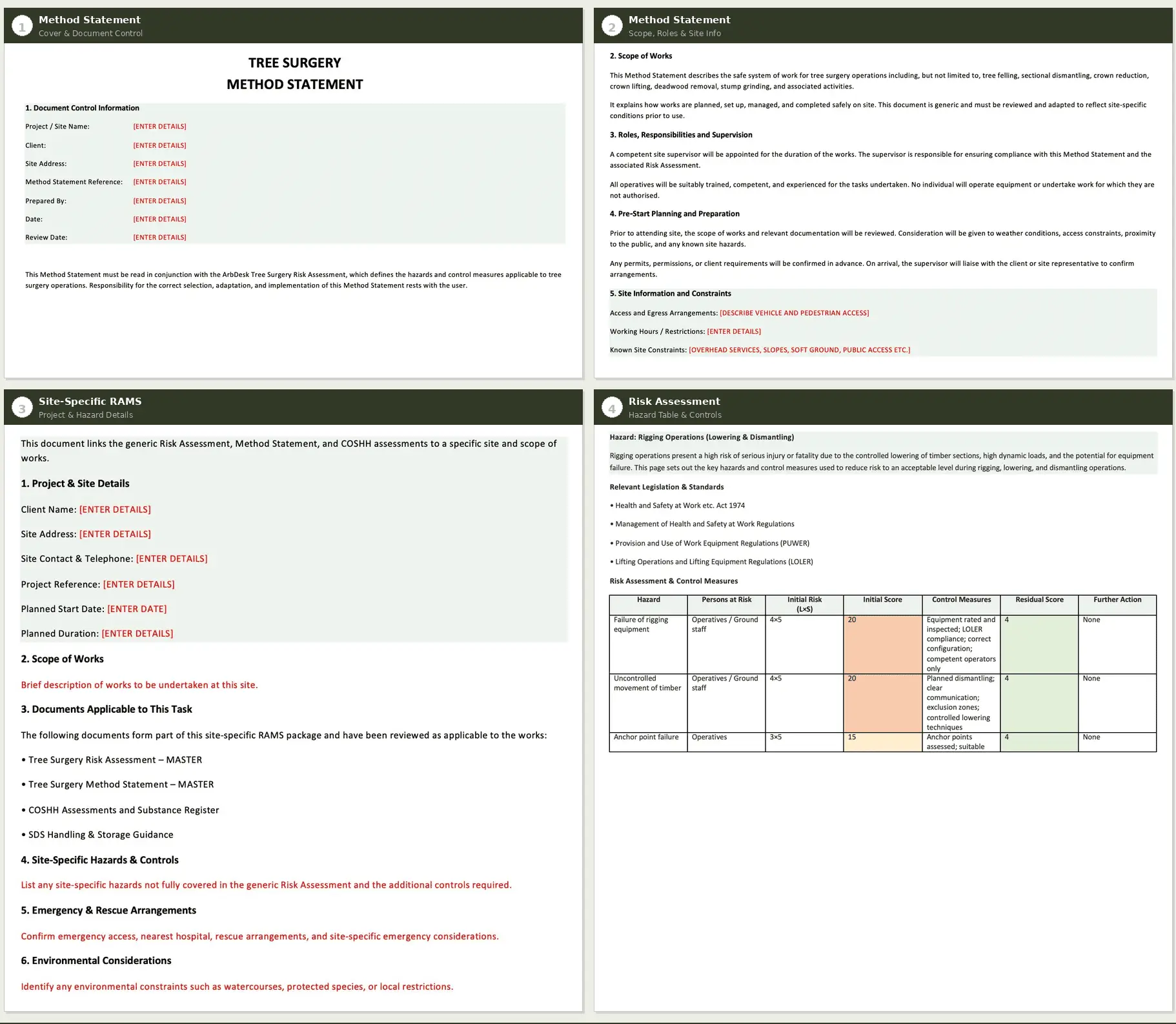
ArbDesk RAMS system — structured for UK commercial arborist work.
What a tree surgery risk assessment template must include
Hazard identification
Clear, specific identification of hazards relevant to arborist work — not generic categories. Each hazard should be named specifically: “chainsaw kickback during pruning” rather than just “chainsaw use”.
Persons at risk
Who specifically may be harmed by each hazard — operators, other operatives, members of the public, site users, residents. The persons at risk should be specific to the situation, not generic.
Initial risk rating
Assessment of the likelihood and severity of harm before controls are applied, typically on a 1-5 x 1-5 matrix producing a risk score. This demonstrates that risks have been evaluated, not just listed.
Control measures
Specific, practical actions that will reduce the risk. Controls must be linked to the actual hazard and reflect how the work will be carried out on site — not generic statements like “wear PPE” without specification.
Residual risk rating
Assessment of the risk level after controls are applied. This demonstrates that the controls are adequate — if the residual risk is still high, additional controls are required before work can proceed safely.
Review and sign-off
The assessment should be signed by the person responsible for the work and show a review date. On commercial sites, operatives may also be required to sign confirmation that they have read and understood the assessment.
Key hazards in tree surgery risk assessments
A professional tree surgery risk assessment must address the full range of hazards specific to arboricultural work. The following are the core hazard categories that should be covered in any commercial submission — generic industrial hazard lists that miss these will immediately identify a document as unsuitable.
Ground-based chainsaw operations
Kickback, cutting contact, chain/bar failure, entanglement, exhaust fumes. Must address operator positioning, PPE specification, chain brake testing and bystander exclusion.
Aerial tree work and climbing
Fall from height, equipment failure, tree structure failure, aerial rescue requirements. Must address climbing system inspection, rescue planning and climber-ground crew communication.
Rigging and sectional dismantling
Uncontrolled lowering, anchor failure, ground crew exposure. Must address rigging point assessment, load estimation, lowering speed control and exclusion zone management.
Falling timber and debris
Uncontrolled falling branches, sections and debris outside the intended drop zone. Must address exclusion zone sizing, drop zone definition and chipper feed management.
Wood chipper operations
Entanglement, ejection, kickback, noise and vibration. Must address operator training, PPE, infeed controls, emergency stop testing and exclusion zone requirements.
Public interface
Unauthorised public access, pedestrian exposure to falling debris, vehicle movement near public. Must address exclusion zone type and size, banksmen, signage and management of breaches.
Manual handling
Lifting and carrying timber, equipment and machinery. Must address timber section size limits, team lifting procedures and equipment-assisted handling for heavy items.
Noise, vibration and dust
HAVS from chainsaw and machinery use, respirable wood dust. Must address exposure limits, rotation controls, RPE requirements and monitoring arrangements for prolonged operations.
How risk rating works in practice for tree surgery
Risk rating is the process of evaluating the level of risk associated with each hazard before and after controls are applied. Most professional RAMS systems use a likelihood x severity matrix — where both factors are scored 1 to 5, producing a risk score from 1 to 25. This gives a structured, reproducible way of demonstrating that risks have been evaluated rather than just listed.
Likelihood score (1-5)
- 1 — Very unlikely: controls virtually eliminate occurrence
- 2 — Unlikely: would require unusual combination of circumstances
- 3 — Possible: could occur under normal working conditions
- 4 — Likely: occurs regularly in similar operations
- 5 — Very likely: certain to occur without controls
Severity score (1-5)
- 1 — Negligible: minor discomfort, no first aid required
- 2 — Minor: first aid required, short absence
- 3 — Moderate: medical treatment, extended absence
- 4 — Major: serious injury, hospitalisation
- 5 — Catastrophic: fatality or permanent disability
The legislation behind tree surgery risk assessments
Requires “suitable and sufficient” risk assessments for all work activities. For commercial arborists, this is the primary legal basis for the risk assessment — and “suitable and sufficient” means genuinely addressing the specific hazards of tree surgery.
All climbing and aerial work must be planned based on a proper risk assessment. The risk assessment must address the specific climbing and rescue requirements for the actual operation — generic references to “working at height” are insufficient.
Equipment use must be assessed as part of the risk assessment — chainsaw, chipper, stump grinder and MEWP hazards must each be specifically addressed. Equipment controls in the assessment should link to pre-use check records.
Risk assessments for construction-type work must be provided to principal contractors before work begins. The assessment must meet CDM standards — which in practice means a structured, site-specific document that addresses the method of work.
Hazardous substances used during tree surgery must be assessed separately under COSHH. The risk assessment should reference the COSHH system — both documents form part of the complete RAMS submission.
Industry guidance defines the expected standard for arborist risk assessment quality. Commercial clients benchmark submissions against AFAG practices — alignment with AFAG is the minimum standard for professional submissions.
Written by a practising arborist
ArbDesk was built by Christian, a working arborist with direct experience submitting RAMS to principal contractors, local authorities and commercial clients across the UK. Every document in the ArbDesk system reflects what actually gets reviewed on commercial sites — not what a generic H&S template assumes reviewers want to see.
The system has been shaped by real submission feedback — what causes rejections, what gets accepted first time, and what commercial clients and councils actually check when they review arborist documentation.
“Proper system built around how arborist work actually runs. Not just a generic template.”
Tree surgery risk assessment — frequently asked questions
Get a professional tree surgery risk assessment system
ArbDesk gives you structured, arborist-specific risk assessments built for UK commercial submissions — with hazard-based templates, risk scoring and control measures developed from real commercial site experience.
Instant access · No app · No subscription · Fully editable documents