
Tree Surgery RAMS Template UK
A tree surgery RAMS template provides the structure for creating risk assessments and method statements for arborist work. For commercial jobs, however, a template alone is rarely enough — the structure must be built around real arborist hazards, adapted for each site, and supported by the records that commercial clients expect alongside it.
This guide covers what a professional tree surgery RAMS template must include, why generic templates consistently fall short on commercial sites, what distinguishes a template from a complete RAMS system, and what to look for when choosing or building your own.
What is a tree surgery RAMS template?
A RAMS template is a structured document framework used to create consistent, professional risk assessments and method statements for tree work. A good template provides the headings, structure and prompts that make sure the right information is captured every time — while remaining editable so that site-specific details can be added for each job.
For UK arborists, RAMS are typically required on any commercial site — council contracts, principal contractor sites, schools, housing developments, estates and facilities management contracts. The template provides the framework; the site-specific information and the quality of the content determine whether the submission is accepted.
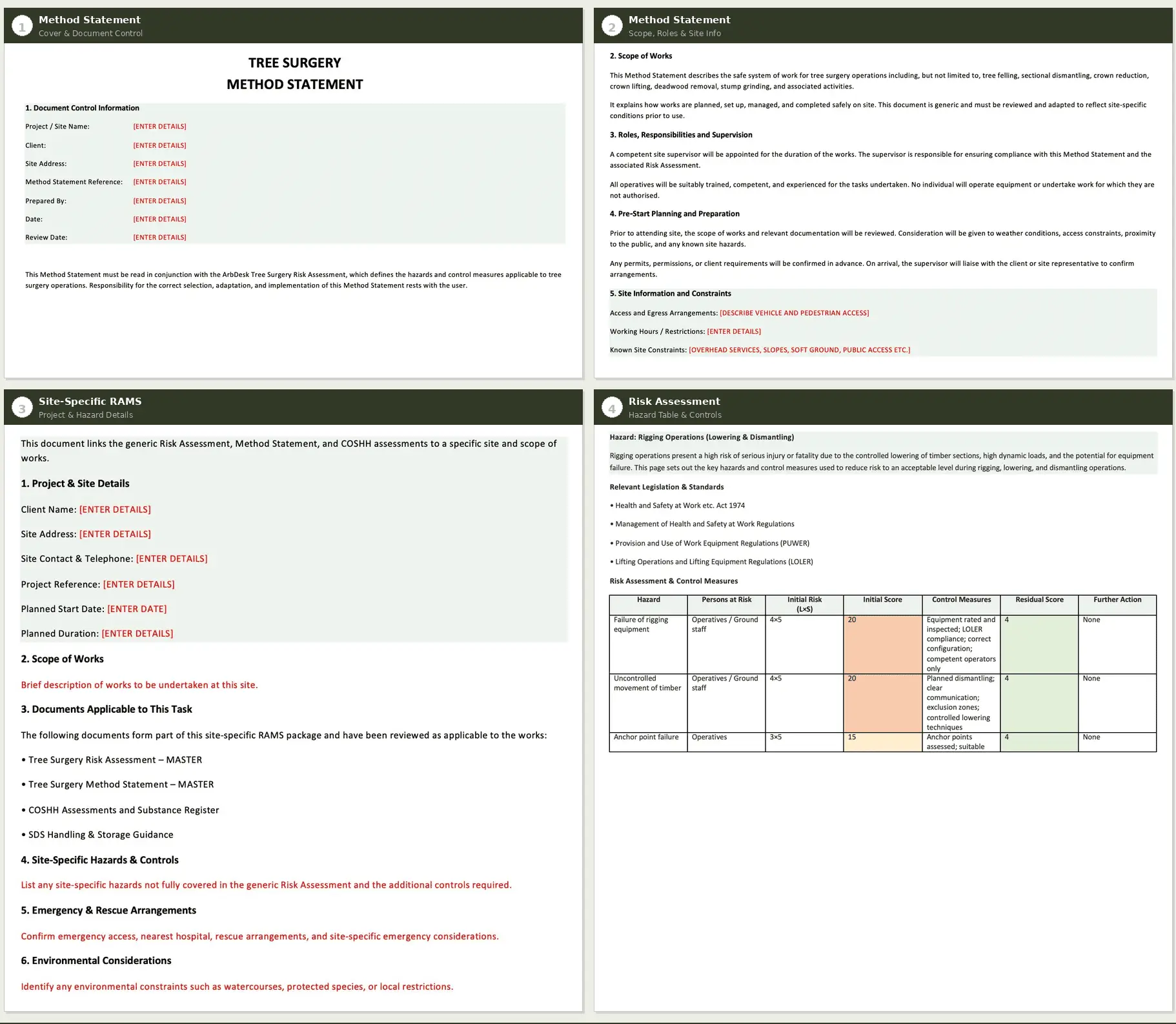
ArbDesk RAMS system — structured for UK commercial arborist work.
What a professional tree surgery RAMS template must include
Risk assessment framework
Hazard identification, risk rating methodology (likelihood x severity), control measures and residual risk. Specific to arborist hazards — not generic office or construction hazards.
Method statement structure
A step-by-step framework that can be adapted to any tree surgery operation — arrival, equipment checks, site setup, access, operations, clearance and completion.
Site-specific sections
Dedicated sections for location, access, emergency arrangements, public interface, environmental considerations and site-specific hazards — with clear prompts for what information is required.
Arborist-specific hazards
Pre-populated hazard library covering chainsaw use, climbing, rigging, chipper and stump grinder operations, public interface and equipment-specific risks.
Competence section
Space to record operator qualifications, equipment authorisations and training completion — structured to provide what commercial clients request.
COSHH reference
Links or cross-references to COSHH assessments for substances used on site — ensuring the RAMS and COSHH system are presented as a coherent document set.
The difference between a RAMS template and a complete RAMS system
Many arborists start with a template and find that it solves only part of the problem. Commercial clients do not just require a completed RAMS document — they expect a complete safety management system that the RAMS document is part of. Understanding the difference is important when choosing what to invest in.
A RAMS template provides
- Structure for risk assessment and method statement
- Consistent formatting across jobs
- Prompts for key information
- A professional document when completed
A complete RAMS system adds
- COSHH assessments for arborist substances
- Equipment pre-use check records (PUWER)
- Site briefing records
- Near miss and incident reporting
- Exclusion zone check records
- Competence declarations and training records
Why generic RAMS templates fall short for commercial tree work
Not arborist-specific
Generic H&S templates are designed for general use and do not include the arborist-specific hazards — chainsaw kickback, rigging failures, aerial rescue — that commercial clients expect to see addressed.
No site-specific structure
Generic templates often lack dedicated sections for the site-specific information — emergency arrangements, nearby hazards, public interface controls — that commercial clients check first.
No method statement
Many “risk assessment templates” do not include a method statement at all. For commercial arborist work, both are required — a risk assessment alone is not a RAMS submission.
No COSHH integration
Generic templates rarely include or reference COSHH assessments — but commercial clients increasingly expect COSHH documentation as part of the RAMS submission package.
No supporting records
A template that produces the RAMS document but not the pre-use checks, briefing records and incident records that support it only solves part of the commercial client’s requirements.
Looks unprofessional
A document that looks like a downloaded generic template makes an immediately worse impression than a professionally structured, branded document — regardless of the content.
What the law requires a RAMS template to address
Risk assessments must be “suitable and sufficient” — meaning they must genuinely address the specific hazards of the work. A template that produces a generic assessment does not satisfy this standard.
Method statement-level documentation is required for work on principal contractor sites. A template that produces only a risk assessment without a method statement does not meet CDM requirements.
Equipment controls must be addressed in the RAMS. A template that does not include dedicated sections for equipment safety, pre-use checks and operator competence will produce incomplete submissions.
COSHH assessments are a separate legal requirement that should be integrated with the RAMS system. A template that does not include or reference COSHH produces an incomplete safety management document set.
Climbing and aerial work controls must be addressed. A template that does not include arborist-specific aerial work sections will produce inadequate RAMS for any job involving climbing.
Commercial clients benchmark RAMS quality against AFAG guidance. A template built around AFAG-aligned arborist practices will produce submissions that meet the industry standard reviewers expect.
Written by a practising arborist
ArbDesk was built by Christian, a working arborist with direct experience submitting RAMS to principal contractors, local authorities and commercial clients across the UK. Every document in the ArbDesk system reflects what actually gets reviewed on commercial sites — not what a generic H&S template assumes reviewers want to see.
The system has been shaped by real submission feedback — what causes rejections, what gets accepted first time, and what commercial clients and councils actually check when they review arborist documentation.
“Proper system built around how arborist work actually runs. Not just a generic template.”
Tree surgery RAMS template — frequently asked questions
See a professional arborist RAMS system
Download the free sample to see how ArbDesk structures RAMS for real UK commercial tree work — and understand what a professional template system looks like in practice.
Instant access · No app · No subscription · Fully editable documents