
COSHH Assessment for Arborists UK
What arborists need to know about COSHH, which substances require assessment, how to write one correctly, and how to build a system that satisfies commercial site requirements.
COSHH and arborists — what you need to know
COSHH stands for Control of Substances Hazardous to Health. The COSHH Regulations 2002 require employers and self-employed workers to assess the risks from hazardous substances used at work and put in place measures to control those risks.
For arborists, this is not a formality. Tree surgery involves daily use of substances that fall under COSHH — fuels, oils, hydraulic fluids, degreasers and marker sprays. Each one requires a formal assessment that identifies the hazard, the route of exposure, the people at risk and the control measures in place.
Failing to have adequate COSHH assessments is a legal breach that can result in enforcement action from the HSE. More practically, principal contractors and commercial clients increasingly require COSHH documentation as part of pre-start RAMS submissions — making a complete COSHH system an essential part of any commercial arborist’s paperwork.
Which substances do arborists need to assess under COSHH?
Most arborists use several COSHH-relevant substances on every job. Each substance requires its own individual assessment — a single generic document covering all substances does not satisfy the COSHH Regulations.
Used in chainsaws and other power tools. Flammable — harmful by inhalation and skin contact. Contains hydrocarbons classified as carcinogens with prolonged exposure.
Used to lubricate chainsaw bars. Mineral oil — risk of skin sensitisation and dermatitis with regular contact. Environmental hazard in water and soil.
Used in MEWPs and hydraulic equipment. Risk of skin and eye contact — high-pressure injection injuries are a serious hazard with hydraulic leaks.
Used to clean equipment and tools. Often solvent-based — risk of inhalation, skin exposure and eye contact. Requires adequate ventilation.
Used to mark trees and work areas. Aerosol — inhalation risk, particularly in enclosed or poorly ventilated spaces. Flammable propellant.
Generated by chainsaws and chippers during processing operations. Fine hardwood dust is classified as a carcinogen — respiratory protection required for prolonged exposure.
Generated during chainsaw operation — particularly relevant in enclosed areas. Contains carbon monoxide and hydrocarbons. Ventilation and exposure time controls required.
Used in stump treatment, vegetation management and grounds maintenance. Strictly regulated under COSHH and the Pesticides Regulations — require separate assessment and application records.
How to carry out a COSHH assessment for arborist work
A COSHH assessment does not need to be complicated, but it does need to cover the right ground. The HSE’s guidance sets out a clear process — each assessment should address six key elements.
Name the substance clearly — include the product name and manufacturer. Obtain the Safety Data Sheet (SDS) for the product from the manufacturer or supplier. This is your primary reference for hazard information and forms part of your COSHH system.
What is it about the substance that could cause harm? Refer to the SDS hazard statements and GHS hazard pictograms. Common hazard types for arborist substances include flammability, skin irritation, respiratory sensitisation, carcinogenicity and environmental hazard.
Who comes into contact with the substance during your work? Consider all operators, apprentices and bystanders. Identify the route of exposure — inhalation, skin contact, ingestion or eye contact — as this determines which control measures are required.
What do you already do to reduce the risk? This includes PPE (gloves, goggles, RPE), ventilation, safe handling procedures, storage arrangements and spill management. Controls must be proportionate to the hazard and route of exposure.
Having identified controls, what is the remaining level of risk? Is it adequately controlled, or are additional measures required? Document the residual risk rating — this demonstrates that the assessment has genuinely been carried out rather than just completed as a form.
Document the completed assessment and keep it accessible to all operatives. Brief workers on the hazards and controls for each substance they use. Review the assessment when working practices change, when new substances are introduced, or at minimum annually.
The COSHH Substance Register and SDS system
Individual assessments for each substance are the starting point. A complete COSHH system for an arborist business also requires a Substance Register — a central record of every COSHH-relevant substance used by the business, with references to the relevant Safety Data Sheets.
Safety Data Sheets (SDS) are provided by manufacturers and contain detailed hazard, handling, storage and emergency information for each product. Your COSHH system should include SDS documents for every substance on your register, and all operatives should know where to find them and how to use them in the event of an emergency.
The SDS Handling and Storage Guidance document sits alongside your assessments and register, providing clear instructions for how substances are to be stored and handled on site — important both for legal compliance and for commercial site submissions where COSHH documentation is reviewed as part of the pre-start approval process.
Every ArbDesk pack includes a complete COSHH system — individual assessments for 8 arborist substances, a Substance Register, SDS Handling and Storage Guidance, and a How To Use guide. Fully editable in Word, structured for commercial site submission.
What the ArbDesk COSHH system includes
The COSHH system is included in every ArbDesk pack — Starter, Pro and Complete. Here is what you get.
A master assessment structured to cover all required COSHH elements — substance identity, hazard, exposure route, persons at risk, existing controls and residual risk rating.
A central log of all COSHH substances used by the business — product name, hazard category, SDS reference, storage location and review date.
Practical guidance covering how substances are to be stored, handled and managed on site — referenced against manufacturer SDS data and structured for site submission.
Pre-completed assessments for the 8 most common arborist substances — Two-Stroke Fuel, Chain Oil, Hydraulic Oil, Degreaser, Marker Spray, Wood Dust and more.
What a complete arborist COSHH system looks like
The ArbDesk COSHH system is structured alongside the RAMS and equipment records — so when you submit to a principal contractor or council, everything is in a consistent format that reviewers recognise and can assess quickly.
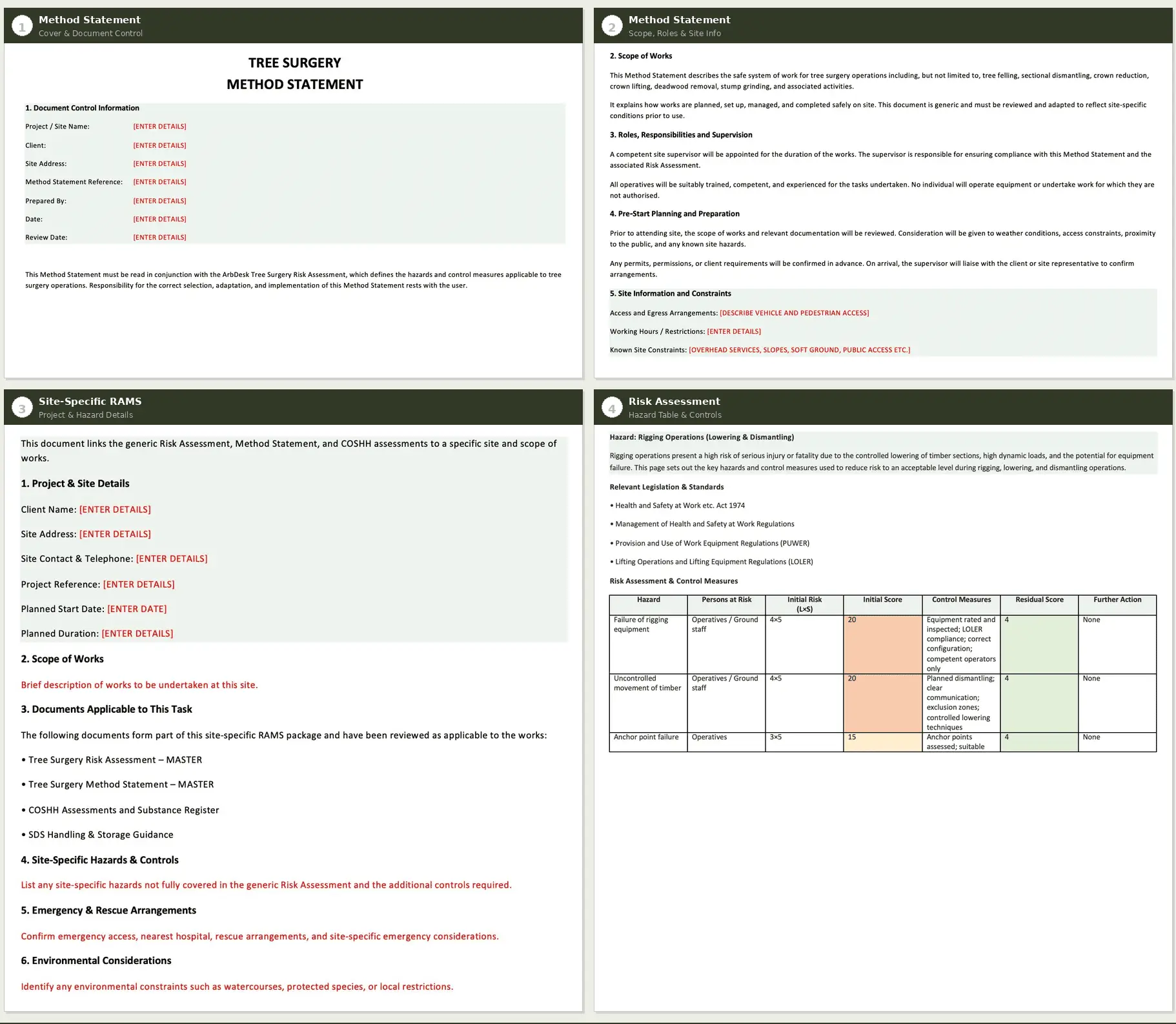
ArbDesk COSHH system — substance assessments, register and SDS guidance structured for UK commercial arborist work.
The legislation behind COSHH for arborists
COSHH sits within a wider framework of health and safety legislation that applies to arborist work. Understanding which regulations apply helps arborists build a compliant system — not just a collection of documents.
The primary legislation. Requires assessment of substances hazardous to health, implementation of control measures, and maintenance of records. Applies to employers and self-employed workers alike.
Requires suitable and sufficient risk assessments for all work activities. COSHH assessments sit within this broader duty and must meet the standard of being suitable and sufficient for the substances and risks involved.
Chainsaws, chippers and other equipment used with or near COSHH substances must be suitable, maintained and operated by competent persons. PUWER and COSHH obligations frequently overlap in arborist operations.
Applies where pesticides or herbicides are used — including stump treatment and vegetation management. Separate from standard COSHH but must be addressed alongside it where relevant to the business.
EU-derived regulations governing chemicals and their Safety Data Sheets. SDS documents produced under REACH provide the hazard information that underpins COSHH assessments — arborists should ensure SDS documents are current.
HSE guidance sets out what adequate COSHH assessments look like in practice. Commercial clients and HSE inspectors use this guidance as the standard against which assessments are judged.
Written by a practising arborist
The ArbDesk COSHH system was built by Christian, a working arborist with direct experience submitting safety documentation to principal contractors, local authorities and commercial clients across the UK. The substance assessments and register are based on what commercial sites actually ask for — not on generic COSHH templates designed for office environments.
Each substance assessment in the ArbDesk system reflects the specific hazards, exposure routes and control measures relevant to arborist work — including substances like chainsaw bar oil and two-stroke fuel that are absent from most generic COSHH template products.
“Proper system built around how arborist work actually runs. Not just a generic template.”
COSHH for arborists — frequently asked questions
More arborist documentation guides
COSHH is one part of a complete arborist safety document system. These guides cover the other key areas.
How to structure a complete RAMS system for commercial tree work — what to include, how it is reviewed, and why structure matters.
Guide PUWER Checklist for Arborists UKWhich equipment PUWER covers, what checks are required, and how to build a compliant pre-use inspection system for arborist work.
Guide Arborist Safety Documents Required UKThe complete overview of safety documents UK arborists need — from RAMS and COSHH through to equipment records and competence declarations.
Get your COSHH system sorted today
Pre-completed COSHH assessments for 8 arborist substances, a Substance Register and SDS guidance — included in every ArbDesk pack. Fully editable in Word, structured for commercial site submission.
One-off payment · instant download · no subscription