
Tree Surgery RAMS for Contractors UK
When working for principal contractors, tree surgery RAMS must do more than satisfy a basic H&S checklist — they need to fit into a controlled site environment, align with contractor safety procedures, and demonstrate that the arborist’s approach is compatible with the site’s overall management system.
This guide covers what principal contractors expect from arborist RAMS submissions, how contractor requirements differ from council or private work, what supporting records are expected alongside RAMS, and how to get contractor RAMS approved first time.
What principal contractors expect from arborist RAMS
Principal contractors occupy a specific role under CDM Regulations 2015 — they are responsible for overall site safety and for managing the interaction between different contractors working on the same site. When they review arborist RAMS submissions, they are not just checking that the tree work itself is safe; they are assessing whether the arborist’s working practices are compatible with their site management system, their site rules and the expectations of their own clients.
This means contractor RAMS review is often more structured and document-specific than private client review. Contractors typically have pre-qualification processes, RAMS templates they want submissions to follow, and specific requirements around competence evidence and supporting records that must accompany the main RAMS document.
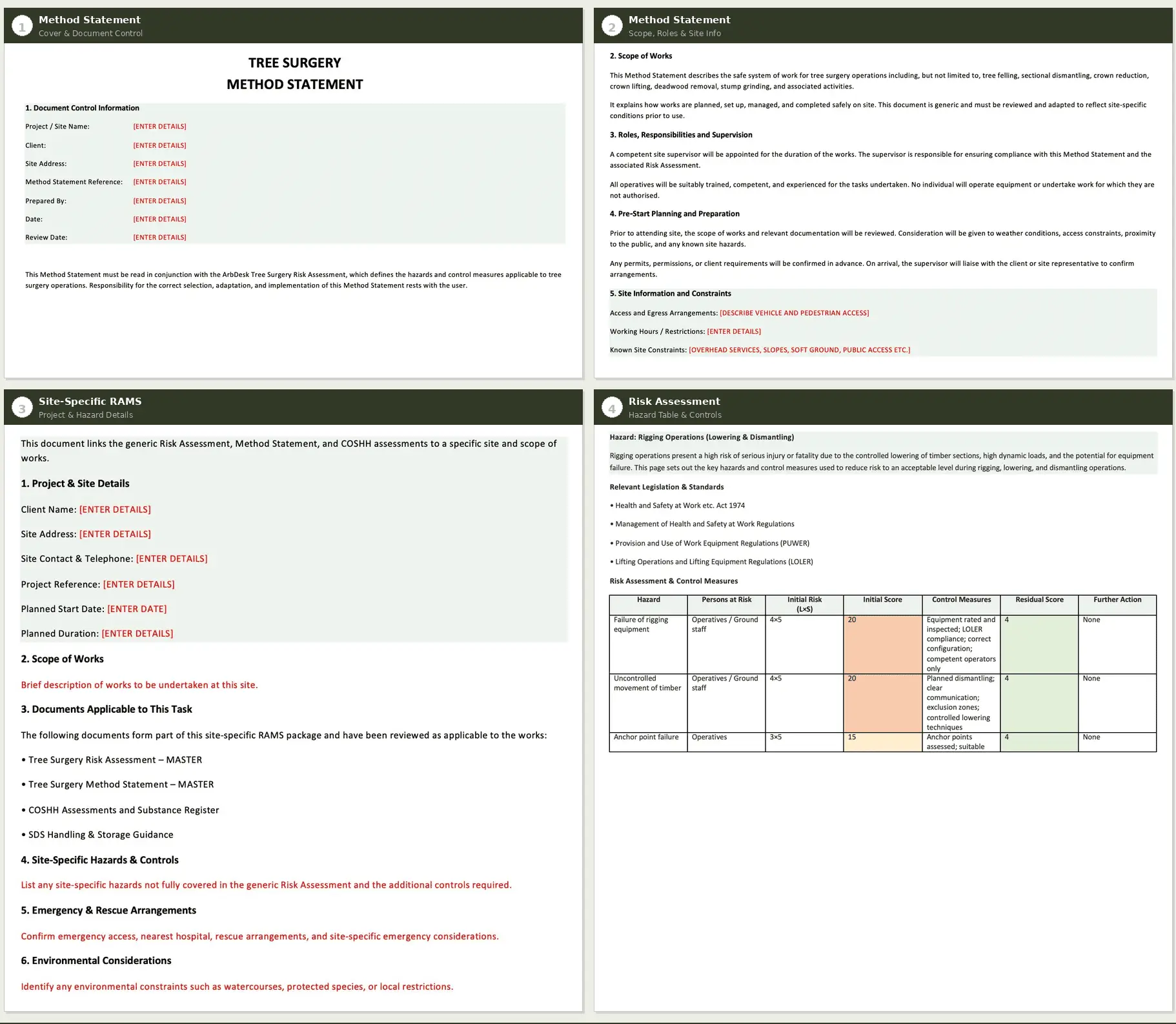
ArbDesk RAMS system — structured for UK commercial arborist work.
What contractor RAMS must include
Core RAMS documents
- Hazard-based risk assessment with risk scoring
- Detailed method statement following the work sequence
- Site-specific information for the contractor’s site
- Integration with contractor site rules and procedures
- Emergency arrangements — A&E, rescue plan, site access
- Operator competence and qualification declarations
- COSHH assessments for substances used
- Equipment pre-use check confirmation
Supporting records expected
- Public liability insurance certificate
- Copies of relevant qualifications
- LOLER thorough examination records (if MEWP involved)
- Site briefing records signed by operatives
- Equipment pre-use check records
- Near miss and incident reporting system evidence
- Contractor portal registration (Constructionline, Achilles etc)
- Site induction completion records
How contractor RAMS differ from council and domestic work
Site integration
Contractor sites often have existing site rules, induction procedures and H&S management systems that arborist RAMS must align with — not just satisfy in isolation. Site-specific rules may override the arborist’s standard approach.
Multi-trade environments
Principal contractor sites often have multiple subcontractors working simultaneously. RAMS must address how the arborist operation will interact with adjacent works — exclusion zone conflicts, noise, access routes and shared welfare facilities.
Procurement portals
Many principal contractors use pre-qualification portals (Constructionline, Achilles, Avetta) as a prerequisite for subcontractor engagement. Portal registration and RAMS submission via the portal are frequently required before any site-specific submission is considered.
CDM compliance
Principal contractors have formal CDM duties — including receiving method statement-level documentation from subcontractors before work begins. RAMS for contractor work must satisfy CDM as well as general H&S law requirements.
Common reasons contractor RAMS get rejected
Generic documents
Documents that read identically for every job signal immediately that the specific contractor site has not been considered.
No multi-trade consideration
Failing to address how the arborist operation interacts with other contractors on the same site is a common and immediate rejection trigger on construction sites.
Missing competence evidence
Principal contractors typically require copies of qualifications rather than just references to them — not having copies available delays the approval process.
No CDM awareness
Documents that fail to acknowledge CDM obligations or the contractor’s role as principal contractor suggest the arborist is not familiar with formal construction site requirements.
Portal not registered
Many principal contractors will not process a RAMS submission until the arborist is registered on their preferred pre-qualification portal — RAMS quality is irrelevant if the prerequisite is missing.
Poorly formatted documents
Documents that are difficult to read, inconsistently formatted or unprofessional in appearance create an immediate negative impression regardless of the quality of the content.
The legal framework for contractor tree surgery RAMS
The primary framework for principal contractor relationships. Principal contractors must receive method statement documentation before subcontractors begin work. CDM compliance is not optional on construction-type sites.
Both principal contractor and arborist subcontractor have independent duties under these regulations. RAMS must satisfy both — the principal contractor’s review is a checkpoint, not a substitute for the arborist’s legal compliance.
Equipment safety records — pre-use checks, maintenance, operator competence — are frequently reviewed by principal contractors as part of subcontractor approval. These must be in place regardless of the principal contractor’s process.
All climbing and aerial work must be planned, supervised and carried out by competent persons. Method statements for contractor sites must address how WAH compliance is maintained.
Principal contractor H&S teams use AFAG guidance as the benchmark for assessing arborist RAMS quality. Alignment with AFAG practices is expected as a minimum for any commercial arborist operation.
Principal contractors and arborist subcontractors both carry duties under HSWA. The principal contractor’s RAMS approval process does not transfer legal responsibility — the arborist remains accountable for their own safe systems of work.
Written by a practising arborist
ArbDesk was built by Christian, a working arborist with direct experience submitting RAMS to principal contractors, local authorities and commercial clients across the UK. Every document in the ArbDesk system reflects what actually gets reviewed on commercial sites — not what a generic H&S template assumes reviewers want to see.
The system has been shaped by real submission feedback — what causes rejections, what gets accepted first time, and what commercial clients and councils actually check when they review arborist documentation.
“Proper system built around how arborist work actually runs. Not just a generic template.”
RAMS for contractors — frequently asked questions
Built for arborists working with contractors
ArbDesk provides structured RAMS, site records and safety systems designed for UK principal contractor and commercial site requirements — everything a contractor pre-qualification process expects to see.
Instant access · No app · No subscription · Fully editable documents