
RAMS for Council Tree Work UK
When carrying out tree work for councils and local authorities, RAMS must clearly demonstrate how the work will be planned, controlled and carried out safely on publicly managed sites. Councils are responsible for public safety on the land they manage — which means they apply a higher level of scrutiny to contractor RAMS than many private clients.
This guide covers what councils expect from arborist RAMS submissions, the hazards specific to council tree work, why submissions get rejected, and how to structure a submission that gets accepted first time.
What local authorities expect from arborist RAMS
Councils and local authorities occupy a particular position as clients — they are simultaneously responsible for the tree work being carried out and for the public safety of the areas where it takes place. This dual responsibility means their RAMS review process is often more structured and detailed than that of private commercial clients.
Most councils operate formal contractor approval processes — some through approved contractor lists, others through procurement portals — and RAMS quality is frequently assessed as part of the tender or onboarding process, not just submitted before individual jobs. An arborist whose RAMS consistently fall short may find themselves removed from approved lists regardless of the quality of their actual tree work.
What council RAMS submissions must include
Council RAMS requirements broadly mirror principal contractor requirements but with additional emphasis on public safety, community impact and the management of sensitive environments. A complete council RAMS submission should include:
Core RAMS documents
- Hazard-based risk assessment with risk scoring
- Step-by-step method statement for the specific site
- Site-specific information — access, nearby hazards, A&E
- Public interface and exclusion zone management
- Traffic management arrangements where applicable
- Emergency arrangements including local A&E location
- Operator competence and qualification references
- COSHH assessments for substances used on site
Additional council expectations
- Public liability insurance evidence
- Equipment pre-use check records (PUWER)
- LOLER thorough examination records for MEWPs
- Site briefing records signed by operatives
- Near miss and incident reporting system evidence
- Environmental management — waste, fuel storage, runoff
- Noise management plan (some council contracts)
- Wildlife protection considerations (nesting birds, bats)
Hazards specific to council tree work
Council tree work often takes place in public environments where the population of people at risk is larger and less predictable than on private sites. The following hazards require particular attention in council RAMS submissions.
Road and footpath proximity
Working alongside or above roads and footpaths — traffic management, pedestrian exclusion, dropped object controls and signage requirements.
School and public building proximity
Work near schools, leisure centres and community buildings — timed exclusions, additional public control during arrival and departure times.
Parks and open spaces
Uncontrolled public access from multiple directions — extended exclusion zones, banksmen deployment, continuous monitoring throughout the operation.
Overhead utilities
Power lines, telecoms cables and street lighting — safe approach distances, UKPN notification requirements and insulation precautions.
Underground services
Gas, water, electricity and telecoms below ground — CAT scan requirements, ground investigation and liaison with utility providers before grinding or excavation.
Environmental sensitivity
Protected species, habitat surveys, TPO implications and waste management — council contracts often carry stricter environmental obligations than private work.
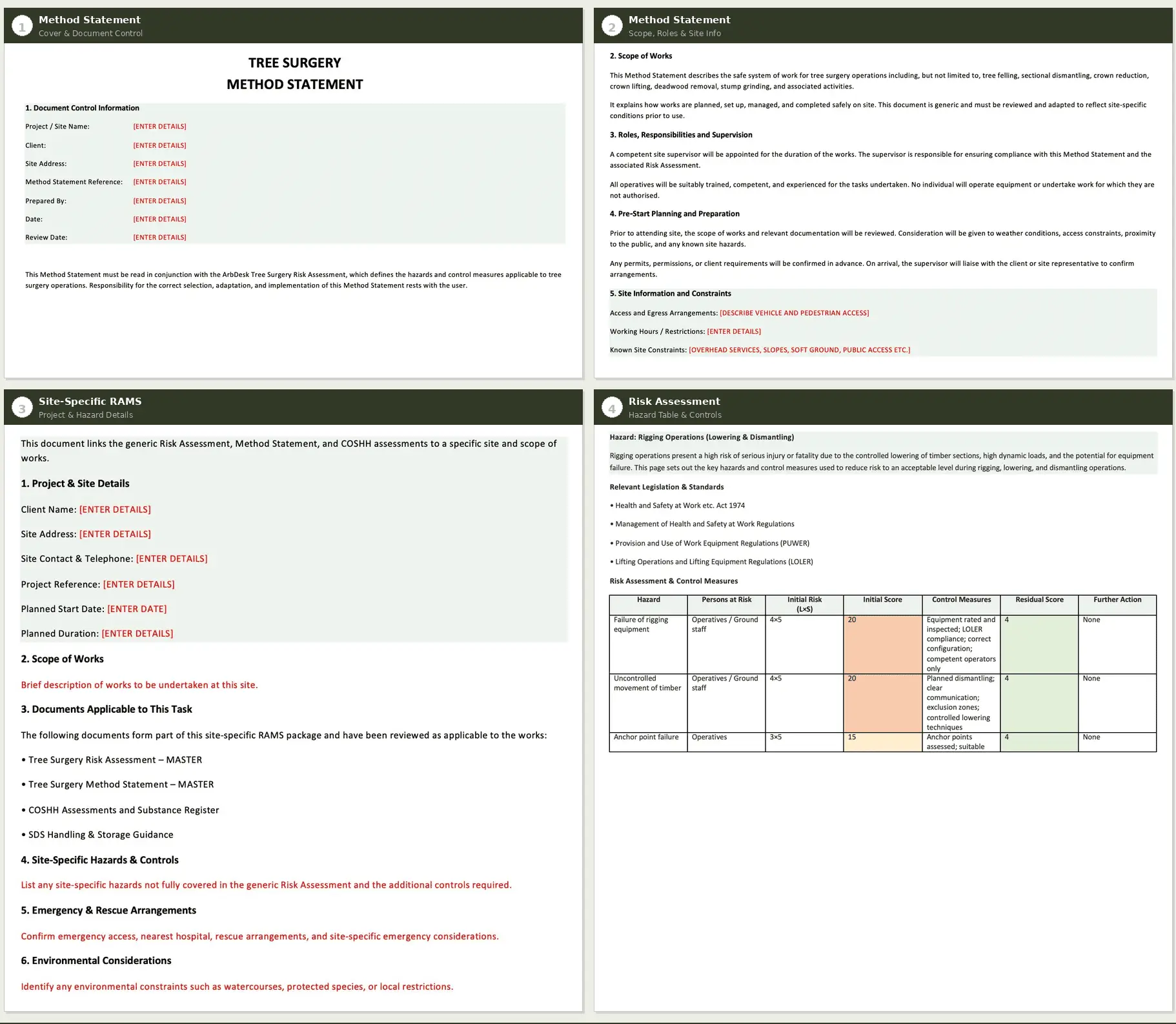
ArbDesk RAMS system — structured for UK commercial arborist submissions to principal contractors and local authorities.
Why RAMS get rejected by councils
RAMS submissions are rejected by councils not because the work is unsafe, but because the documentation does not clearly demonstrate how the work will be carried out in the specific public environment. The most common reasons are structural and specific to the public-facing nature of council work.
Generic public safety controls
Vague statements about “maintaining exclusion zones” without specifying zone size, barrier type, signage or banksmen deployment for the specific site.
No traffic management plan
Any work alongside or above a road requires a traffic management plan — often separate from the RAMS, but referenced within it.
Missing emergency information
The local A&E location, emergency services access route and first aid provision are consistently checked in council submissions and frequently missing.
No environmental considerations
Wildlife, waste and environmental impact are increasingly expected in council RAMS — particularly for work in parks, conservation areas and protected sites.
Competence not evidenced
Council procurement teams often require qualification copies alongside RAMS — not just a reference to qualifications within the document.
Generic method statement
A method statement that reads identically for every job immediately signals that the specific site has not been considered — a common and immediately obvious rejection trigger.
The legislation behind council tree work RAMS
The primary duty for risk assessment. Council contracts typically require RAMS that meet the “suitable and sufficient” standard — generic documents do not.
Where councils act as clients under CDM, RAMS submissions from arborist subcontractors must satisfy CDM requirements — including method statement documentation.
Where work affects the highway, Section 59 notices and traffic management plans may be required. RAMS should reference these where applicable.
Protection of nesting birds and other protected species. Council contracts often require evidence that wildlife considerations have been addressed before work begins.
Equipment safety records including pre-use checks and LOLER thorough examinations are standard council contract requirements alongside RAMS.
Council H&S teams benchmark arborist RAMS against AFAG guidance. Alignment with AFAG safe systems of work is expected as a minimum standard.
Written by a practising arborist
ArbDesk was built by Christian, a working arborist with direct experience submitting RAMS to principal contractors, local authorities and commercial clients across the UK. Every document in the ArbDesk system reflects what actually gets reviewed on commercial sites — not what a generic H&S template assumes reviewers want to see.
The system has been shaped by real submission feedback — what causes rejections, what gets accepted first time, and what commercial clients and councils actually check when they review arborist documentation.
“Proper system built around how arborist work actually runs. Not just a generic template.”
RAMS for council tree work — frequently asked questions
Built for arborists working commercially
ArbDesk gives you a complete, structured RAMS system — risk assessments, method statements, COSHH, equipment records and operational safety documents built around what UK commercial clients actually expect to see.
Instant access · No app · No subscription · Fully editable documents
You may also find these useful