
Wood Chipper Risk Assessment UK
A wood chipper risk assessment identifies the hazards involved in operating a wood chipper during arborist work and sets out the control measures required to carry out the operation safely. Wood chippers are among the highest-risk pieces of equipment used in commercial tree surgery — entanglement, ejected debris and operator positioning are serious hazards that require formal assessment.
This guide covers the key hazards of chipper operation, what control measures must be in place, the legal requirements that apply under PUWER and the Management of Health and Safety Regulations, and how a wood chipper risk assessment connects to your wider arborist RAMS system.
What is a wood chipper risk assessment?
A wood chipper risk assessment is a structured document identifying the hazards associated with feeding, operating and positioning a wood chipper during arborist work, assessing the risk level for each hazard, and setting out the controls that will reduce those risks to an acceptable level before work begins.
For commercial arborist work, chipper risk assessment is not a standalone document — it forms part of the wider RAMS submission alongside chainsaw risk assessments, climbing risk assessments, site-specific information and method statements. Commercial clients and principal contractors reviewing RAMS expect to see chipper hazards specifically addressed rather than covered by a generic reference to “machinery use”.
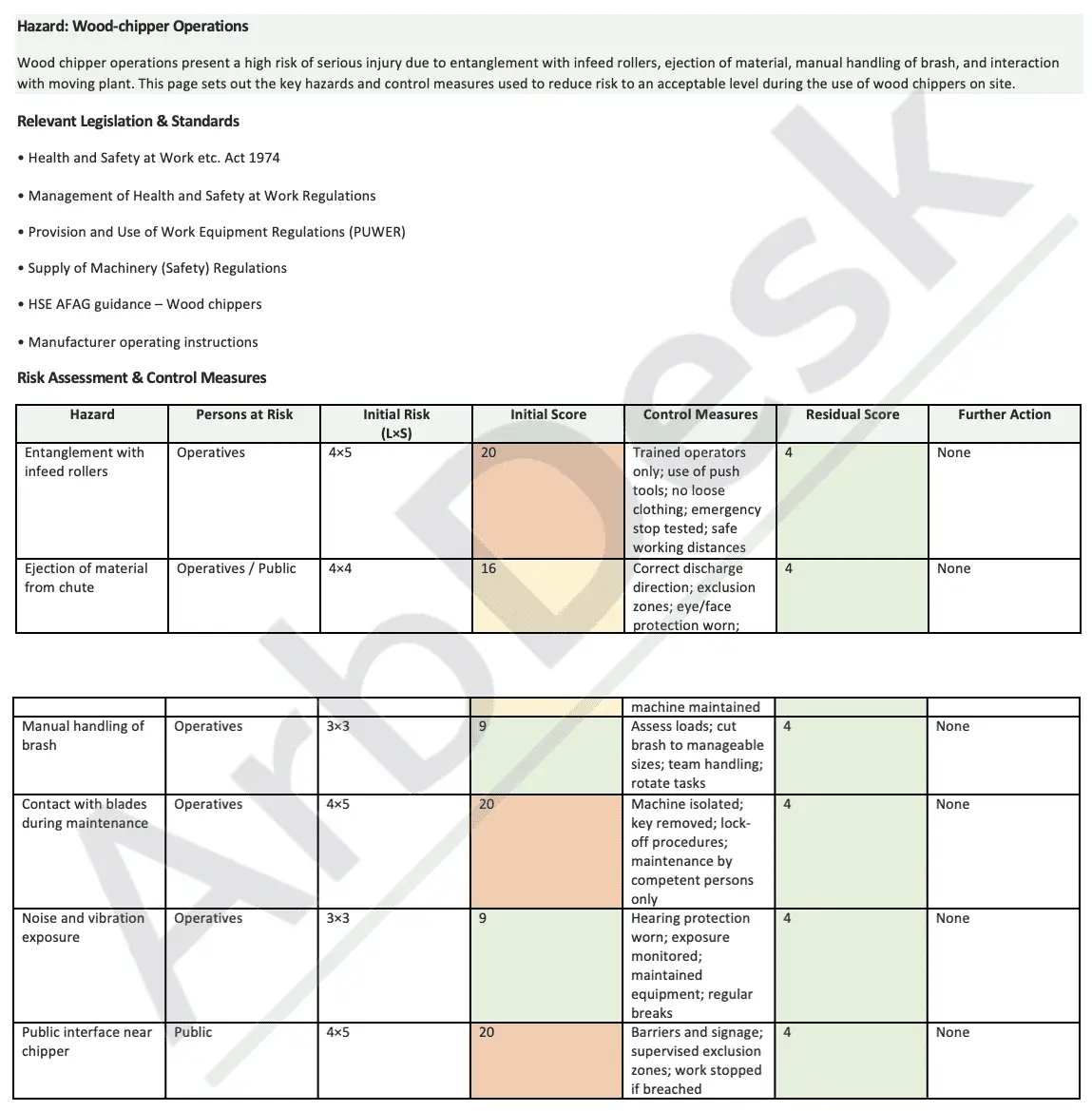
ArbDesk RAMS system — Wood-chipper Risk Assessment Preview – structured for UK commercial arborist work.
Hazards in a wood chipper risk assessment
Entanglement in infeed rollers
The most serious chipper hazard. Clothing, limbs or hair being pulled into the infeed by the feed rollers — potentially fatal. Operator training, positioning, clothing controls and emergency stop familiarity must all be addressed.
Ejection and kickback
Material ejected from the infeed chute or kicked back by the drum — including branches, stones, offcuts and debris. Operator positioning relative to the infeed, PPE and exclusion zone management must be addressed.
Flying debris from discharge
Wood chips and debris ejected at high velocity from the discharge chute. Discharge direction, exclusion zone for bystanders, PPE for persons within the risk zone.
Manual handling — feeding
Lifting, carrying and feeding heavy branches into the infeed — particularly relevant for large diameter material or prolonged operations. Team handling procedures, feeding technique and material size limits.
Noise and hearing damage
High noise levels during chipper operation — HAVS and hearing damage risk. Hearing protection for all persons within the noise zone, exposure time monitoring for prolonged operations.
Exhaust fumes
Carbon monoxide and hydrocarbon exposure during petrol or diesel chipper operation — particularly in enclosed spaces or with the engine positioned near operatives. Positioning and ventilation controls required.
Towing and positioning hazards
Chipper positioning on uneven ground, reversing with trailer, coupling and decoupling, and stability during operation. Towing competence, ground assessment and spotter requirements.
Public interface
Members of the public entering the work area — particularly relevant when operating in parks, footpaths and residential environments. Exclusion zone, banksmen, discharge direction management.
Control measures for wood chipper operations
Before starting
- Pre-use check completed and recorded — emergency stop, infeed controls, guards
- Exclusion zone established for ejection and kickback risk
- Discharge chute directed away from public areas and team members
- Ground stability assessed — no operation on significantly sloping ground without controls
- Operator confirmed as trained and competent on this specific chipper
- All team members briefed on emergency stop location and procedure
During operation
- Full PPE worn — helmet, eye protection, hearing protection, gloves, chainsaw boots
- No loose clothing, untied hair or dangling lanyards near infeed
- Never reach into the infeed chute — use feed tools for small material
- Feed from the side — never stand directly in line with the infeed
- Exclusion zone maintained — banksman monitors during operation
- Machine stopped before any adjustment, blockage clearance or inspection
PUWER and the legal basis for chipper risk assessment
Wood chippers are work equipment — PUWER requires them to be suitable for purpose, properly maintained and used only by trained, competent operators. Pre-use checks, maintenance records and operator competence must be documented.
Requires suitable and sufficient risk assessment for chipper operations. A generic reference to “machinery use” does not meet this standard — chipper-specific hazards must be addressed.
Wood chippers typically exceed the lower exposure action value of 80dB(A). Hearing protection must be provided and operators monitored for hearing damage risk during prolonged use.
Feeding heavy material into chippers requires manual handling assessment. Team handling procedures, feeding technique and material size limits must address this risk.
Towing a chipper on public roads requires the towing vehicle and trailer to comply with road traffic legislation. Coupling security, lighting boards and overall length limits must be considered.
AFAG provides specific guidance on safe chipper operation that sets the industry standard. Commercial clients benchmark chipper risk assessment against AFAG practices as the minimum acceptable standard.
Written by a practising arborist
ArbDesk was built by Christian, a working arborist with direct experience submitting RAMS to principal contractors, local authorities and commercial clients across the UK. Every document in the ArbDesk system reflects what actually gets reviewed on commercial sites — not what a generic H&S template assumes reviewers want to see.
The system has been shaped by real submission feedback — what causes rejections, what gets accepted first time, and what commercial clients and councils actually check when they review arborist documentation.
“Proper system built around how arborist work actually runs. Not just a generic template.”
Wood chipper risk assessment — frequently asked questions
Get your wood chipper risk assessment included
The ArbDesk Pro Pack includes wood chipper risk assessment as part of a complete commercial RAMS system — alongside chainsaw, stump grinder, climbing and equipment assessments, all structured for UK commercial submissions.
Instant access · No app · No subscription · Fully editable documents
You may also find these useful