
Stump Grinder Risk Assessment UK
A stump grinder risk assessment identifies the hazards involved in stump grinding operations and sets out the control measures required to carry out the work safely on site. For arborists, stump grinding is one of the higher-risk equipment operations — ejected debris, underground services, machinery instability and public exposure all require formal assessment.
This guide covers the key hazards of stump grinding, what control measures must be in place, the legal requirements that apply under PUWER and the Management of Health and Safety Regulations, and how a stump grinder risk assessment fits within a complete arborist RAMS submission.
What is a stump grinder risk assessment?
A stump grinder risk assessment is a structured document that identifies the hazards associated with stump grinding equipment and the working environment, assesses the level of risk, and sets out the control measures required before, during and after the operation. It forms part of a wider arborist RAMS submission and should be linked to the method statement and site-specific risk assessment that accompany it.
For commercial tree work, stump grinding is rarely assessed in isolation — it typically forms part of a broader risk assessment covering the full scope of work on site. However, where stump grinding is a significant or standalone operation, a dedicated assessment helps demonstrate that its specific hazards have been properly considered rather than addressed generically within a broader document.
Hazards that a stump grinder risk assessment must address
Stump grinding involves a rotating cutting wheel operating at high speed in contact with wood, soil and stone. The combination of machine characteristics and typical working environments creates a specific hazard profile that must be formally assessed.
Flying debris and ejected material
High-speed cutting ejects wood chips, stones, soil and other material at significant velocity. Risk to operators, bystanders and property. Exclusion zone size, barrier type and PPE must reflect this specific hazard.
Contact with cutting wheel
Serious injury or fatality risk if guards are bypassed, controls are misused or the operator enters the cutting zone. Operator training, guard maintenance and safe working distances must be addressed.
Underground services
Gas pipes, electricity cables, water mains and telecoms below or near the stump. CAT scanning, service records and careful approach to grinding depth must be addressed before work begins.
Machine instability
Stump grinders can become unstable on sloping, soft or uneven ground. Ground assessment, machine positioning and operator positioning must be addressed in the risk assessment.
Public interface
Members of the public approaching the work area during operation — particularly relevant in parks, footpaths and residential settings. Exclusion zone management, banksmen and signage requirements.
Noise, vibration and dust
High noise levels, HAVS risk from machine vibration and wood/soil dust. Exposure time controls, RPE and HAVS monitoring should be addressed where operations are prolonged.
Manual handling and access
Moving and positioning the stump grinder — particularly tracked machines on slopes or through narrow access. Manual handling assessment and machine movement controls required.
Hydraulic system failures
High-pressure hydraulic injection injuries from leaks in the hydraulic system during operation. Pre-use checks, maintenance records and operator awareness of hydraulic hazards.
Control measures required in a stump grinder risk assessment
Control measures in a stump grinder risk assessment must be specific, realistic and linked to the actual hazards identified. Generic statements like “use PPE” or “maintain a safe distance” are not sufficient — controls must describe what specific actions will be taken and how they reduce the risk.
Before work begins
- CAT scan or service record check for underground services
- Ground stability assessment — no operation on soft or sloping ground without risk controls
- Pre-use check of cutting wheel, guards, controls and hydraulics
- Exclusion zone established — minimum size determined by machine and ejection risk
- Signage and barriers in place
- Banksman deployed where public access cannot be fully controlled
- Operator confirmed as trained and competent on this specific machine
During the operation
- Full face protection and hearing protection worn throughout
- No persons within exclusion zone during operation
- Operator remains in control position at all times during cutting
- Machine stopped before any adjustment, inspection or clearing
- Grinding depth controlled — no excessive depth without service confirmation
- Dust suppression where prolonged operation creates respiratory risk
- Exclusion zone maintained — banksman monitors throughout
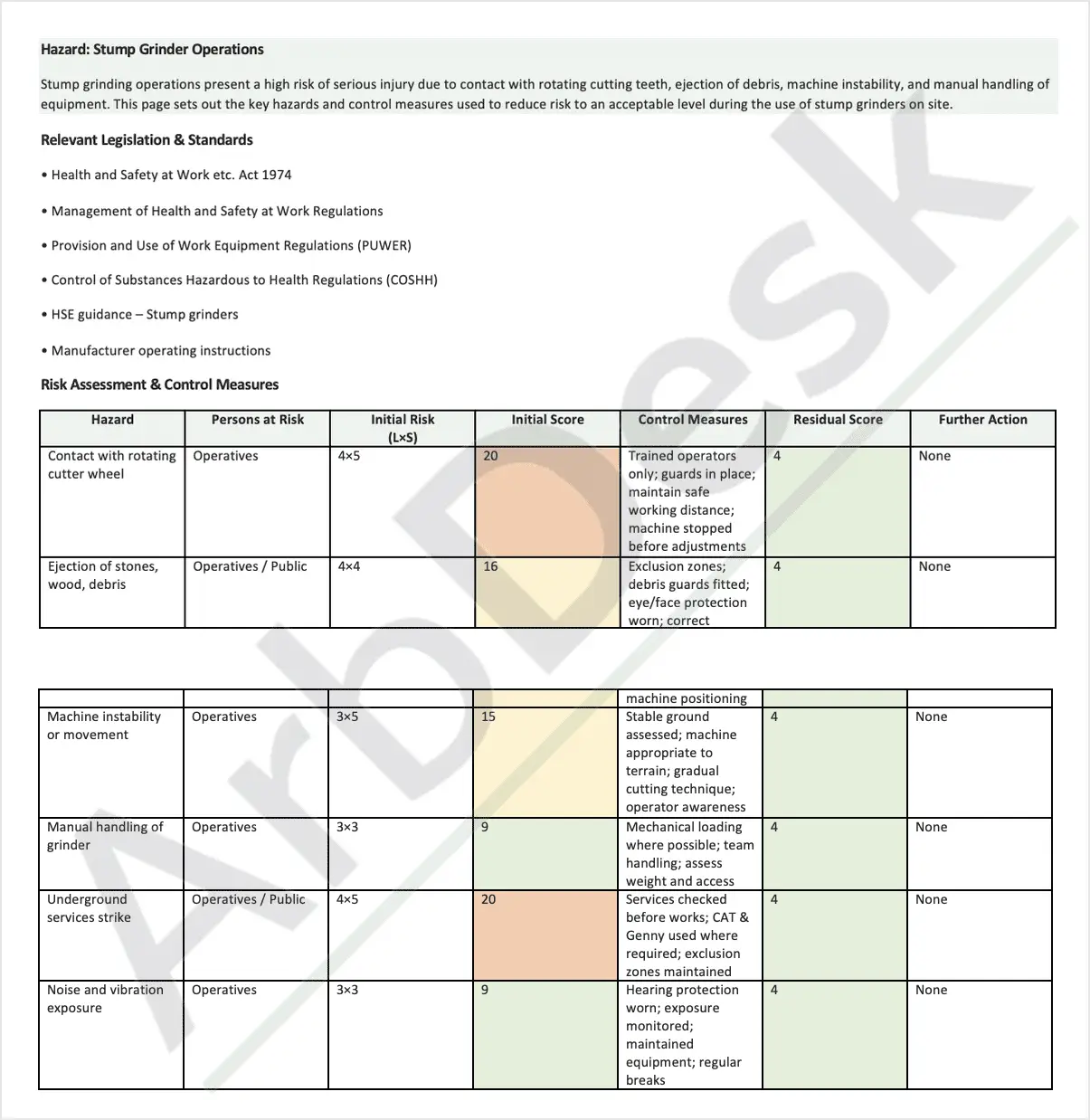
ArbDesk RAMS system — Stump Grinder Risk Assessment Preview – structured for UK commercial arborist work.
PUWER and the legal basis for stump grinder risk assessment
Stump grinders are work equipment — PUWER requires them to be suitable, maintained and operated by trained, competent persons. Pre-use checks, maintenance records and operator training must all be in place.
Requires suitable and sufficient risk assessment for all work activities. Stump grinding must be specifically assessed — reference to chainsaw or general equipment controls is not sufficient.
Hand-arm vibration from stump grinder handles must be assessed where exposure is significant. Prolonged operation may require HAV monitoring and rotation controls.
Dust from stump grinding operations — particularly in enclosed areas or on prolonged jobs — may require COSHH assessment for respirable wood dust and soil particles.
Where underground services are present, specific requirements apply before grinding can proceed. Failure to identify and protect underground utilities is a serious legal and safety risk.
AFAG guidance on stump grinding sets out expected standards for operator training, machine guarding, exclusion zones and pre-use checks. Commercial clients benchmark submissions against AFAG.
Written by a practising arborist
ArbDesk was built by Christian, a working arborist with direct experience submitting RAMS to principal contractors, local authorities and commercial clients across the UK. Every document in the ArbDesk system reflects what actually gets reviewed on commercial sites — not what a generic H&S template assumes reviewers want to see.
The system has been shaped by real submission feedback — what causes rejections, what gets accepted first time, and what commercial clients and councils actually check when they review arborist documentation.
“Proper system built around how arborist work actually runs. Not just a generic template.”
Stump grinder risk assessment — frequently asked questions
Get your stump grinder risk assessment included
The ArbDesk Pro Pack includes stump grinder risk assessment as part of a complete commercial RAMS system — alongside chainsaw, wood chipper, climbing and equipment assessments, all structured for UK commercial arborist submissions.
Instant access · No app · No subscription · Fully editable documents
You may also find these useful