
Equipment Pre-Use Checks for Arborists UK
Equipment pre-use checks help arborists confirm that tools, machinery and vehicles are safe before work begins. For commercial tree work, they are a key part of PUWER compliance and a practical demonstration that equipment safety is actively managed on site.
This guide covers what PUWER pre-use checks must cover for arborist equipment, how to record them, what commercial sites expect to see, and why they matter beyond just ticking a box.
What are equipment pre-use checks for arborists?
Equipment pre-use checks are basic inspections carried out before tools or machinery are put into use on site. The purpose is to identify obvious defects, damage or safety issues before work begins — not to replace formal maintenance schedules or annual inspections, but to catch problems that could cause an incident on the day.
For arborists, this covers a wide range of equipment — chainsaws, wood chippers, stump grinders, MEWPs, vehicles, trailers, climbing equipment and hand tools. Each piece of equipment has specific things that need to be checked, and each check should be recorded so there is a documented record that the inspection took place.
What an ArbDesk pre-use check looks like
ArbDesk pre-use checks are designed to be simple, practical and quick to complete on real jobs — covering all the key inspection points without unnecessary complexity.
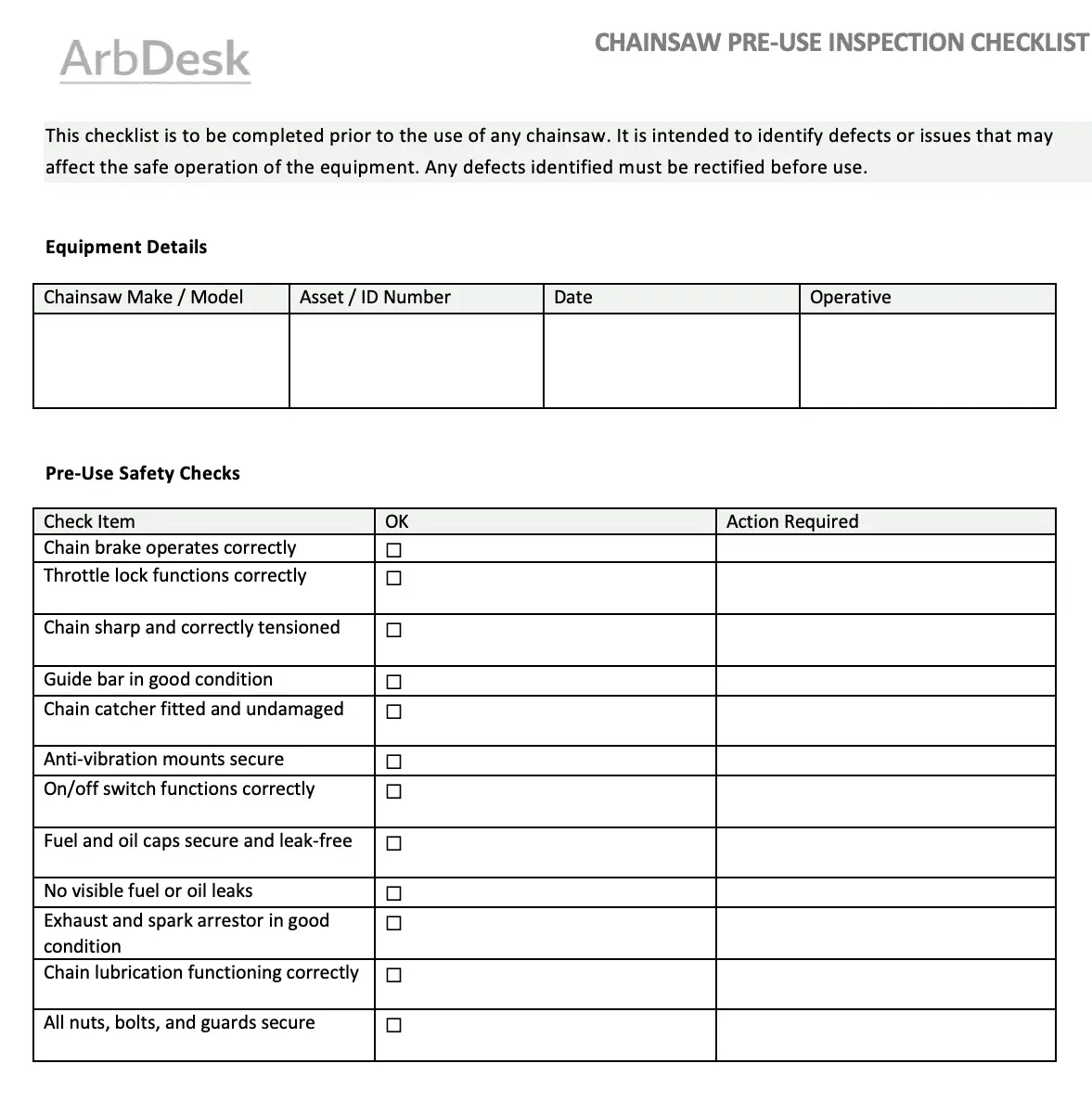
Example ArbDesk equipment pre-use check — structured for UK commercial arborist use and included in every ArbDesk pack.
Arborist equipment pre-use check requirements by type
Each type of equipment used in arborist work has specific inspection points that should be covered before use. The following covers the key checks for the main categories of equipment used on commercial tree work sites.
Chainsaws
- Chain condition — sharpness, tension and wear
- Chain brake function — check before every use
- Throttle trigger lockout operation
- Chain catcher condition
- Bar condition — rails, groove, sprocket nose
- Oiling system — bar oil level and flow
- Fuel system — no leaks, cap secure
- Handles, anti-vibe mounts and general condition
Wood chippers
- Emergency stop — test before operation
- Infeed controls and reverse function
- Rotor guards and feed rollers
- Discharge chute — direction and security
- Fluid levels — hydraulic, oil, coolant
- Tyres and wheel fixings
- Towing connection and lighting board
- Knife condition (record in maintenance log)
Stump grinders
- Cutting wheel — teeth condition and security
- Guards and deflectors in place
- Engine and hydraulic controls
- Stability on ground — no tipping risk
- Fluid levels and leaks
- Safe access around work area
- Buried services — check before starting
MEWPs
- Platform and basket condition
- Controls — upper and lower function
- Emergency lowering system
- Harness anchor points
- Tyres or tracks — condition and pressure
- Outrigger operation and ground conditions
- Fluid levels and leaks
- LOLER thorough examination in date
Vehicles and trailers
- Lights — front, rear, indicators, brake lights
- Tyres — condition and pressure
- Brakes — function and handbrake
- Towing connection — hitch, safety chains, electrics
- Loads — secure, within capacity, covered if required
- Mirrors and visibility
- Fuel and fluid levels
Climbing equipment
- Harness — webbing, stitching, buckles, no cuts or abrasion
- Helmets — no cracks, chin strap secure
- Lanyards and connectors — gates, locks, wear
- Ropes — condition, no core damage, kinks or chemical exposure
- Karabiners — gate function, no deformation
- Pulleys and friction devices — wear and function
How pre-use checks link to PUWER and UK law
Equipment pre-use checks are a practical part of compliance with the Provision and Use of Work Equipment Regulations 1998 (PUWER). PUWER requires that all work equipment is suitable for purpose, maintained in a safe condition, and used only by people who are trained and competent to use it. Pre-use checks are how arborists demonstrate in practice that equipment is in a safe condition before each use.
PUWER is not the only legislation that applies. The following regulations all create duties that pre-use check records help satisfy:
Requires work equipment to be suitable, maintained and used safely by competent persons. Pre-use checks are the practical daily expression of this duty — confirming equipment is fit for use before it is put into operation.
Requires risk assessments to be carried out and control measures put in place. Pre-use check records demonstrate that the equipment controls listed in RAMS documents are actually being applied in practice on site.
Lifting Operations and Lifting Equipment Regulations require thorough examination of lifting equipment including MEWPs. Pre-use checks are separate from — but complementary to — LOLER thorough examinations and should confirm the LOLER record is in date.
All equipment used for work at height — including climbing harnesses, ropes, lanyards and MEWPs — must be inspected regularly by a competent person. Pre-use checks are a key part of this duty.
The overarching duty to ensure the health, safety and welfare of employees and others affected by the work. Documented pre-use checks demonstrate that this general duty is being actively discharged.
Arboriculture and Forestry Advisory Group guidance sets out expected pre-use inspection standards for arborist equipment. Commercial clients expect RAMS and supporting records to align with AFAG best practice.
Why recording pre-use checks matters
Carrying out checks is the first step — recording them is what makes them useful for compliance, commercial submissions and protection if something goes wrong. A check that is not documented may as well not have happened from a legal or contractual standpoint.
What recorded checks give you
- Evidence that equipment was inspected before use
- A record of any defects identified and action taken
- Consistency across different operatives and jobs
- Supporting documentation for commercial RAMS submissions
- Protection if an incident occurs and equipment condition is questioned
- A basis for maintenance scheduling and defect tracking
Common failures without recorded checks
- Checks carried out but not recorded — no evidence they happened
- Defects noticed but not followed up or taken out of service
- Different operatives checking different things inconsistently
- No link between equipment controls in RAMS and site practice
- Vehicle and towing checks overlooked entirely
- LOLER or maintenance records out of date — not caught at pre-use stage
How pre-use checks fit into your wider RAMS system
Pre-use check records are strongest when they connect directly with the risk assessments and method statements used for the job. If your RAMS lists equipment controls as part of the hazard management for chainsaw use, chipper operation or climbing, those controls need to be backed up by evidence that the checks are actually happening on site.
Risk assessment → equipment controls
Your risk assessment lists equipment control measures — PPE, pre-use checks, maintenance records. Pre-use check sheets are the evidence that those controls are applied in practice.
Method statement → equipment sequence
Your method statement describes how equipment will be used on site. Pre-use checks confirm that the equipment is in a condition to be used safely in the sequence described.
PUWER compliance → documented checks
PUWER requires equipment to be maintained and checked. Pre-use check records are the practical documentation layer that sits between the legal duty and the work on site.
Commercial submissions → supporting records
Principal contractors and local authorities expect pre-use check systems alongside RAMS. Having documented records to show is often the difference between a complete submission and a resubmission request.
Written by a practising arborist
The ArbDesk pre-use check system was built by Christian, a working arborist with direct experience of what commercial sites expect when they ask to see your equipment safety records. The check sheets in ArbDesk are not adapted from generic industrial templates — they are built around the equipment arborists actually use and the specific points that matter for tree surgery operations.
Each check sheet covers the inspection points that HSE inspectors, principal contractor H&S teams and local authority site managers look for — designed to be completed quickly on site without unnecessary complexity, but comprehensively enough to serve as proper documented evidence of equipment inspection.
“Proper system built around how arborist work actually runs. Not just a generic template.”
Equipment pre-use checks — frequently asked questions
Built for arborists who need more than RAMS alone
The ArbDesk Pro Pack includes the full RAMS system plus equipment pre-use check records, daily site briefing records, exclusion zone checks and incident reporting — everything needed for a complete commercial site submission.
Instant access · No app · No subscription · Fully editable documents
You may also find these useful