
Site-Specific Risk Assessment for Tree Work UK
A site-specific risk assessment is the element of your RAMS that adapts your general tree work controls to the actual site you are working on. It is the difference between a document that could apply to any tree job and one that clearly demonstrates the specific location, hazards, people at risk and emergency arrangements have been properly considered.
This guide covers what a site-specific risk assessment must include, why it is consistently the weakest element in commercial RAMS submissions, the hazards it must address, and how to structure one that satisfies principal contractors and local authorities first time.
What is a site-specific risk assessment for tree work?
A site-specific risk assessment is the part of your RAMS that looks beyond the standard task hazards and considers the actual location being worked on. Where a general risk assessment covers the hazards associated with chainsaw use, climbing or chipper operation in principle, the site-specific assessment addresses how those hazards are affected by this particular site — its access, the people nearby, the surrounding environment and the specific conditions on the day.
For arborists, site-specific assessments are non-negotiable on commercial work. A risk assessment that reads identically for every job is immediately identifiable to any experienced reviewer — and is one of the most common reasons RAMS submissions are sent back for revision.
What a site-specific risk assessment must cover
Every site-specific risk assessment for tree work should address the following elements. The level of detail required increases with the complexity of the site and the nature of the client.
Site identification
Client name, site address, date of assessment, job description and the person carrying out the assessment. This information anchors the document to the specific job.
Access and layout
How the site is accessed, where equipment will be positioned, how operatives will arrive and leave, and any restrictions on access times or access routes.
Site-specific hazards
Overhead lines, underground services, slopes, water features, fragile surfaces, restricted space, poor visibility and any unusual ground conditions specific to this location.
People at risk
Who specifically may be affected — residents, pedestrians, passing traffic, school children, other contractors on site, and any particularly vulnerable groups in the vicinity.
Public interface controls
How the public will be kept away from the work area — exclusion zone size and type, signage placement, banksmen positions, and how the exclusion zone will be maintained throughout the operation.
Emergency arrangements
The location of the nearest A&E hospital, how emergency services would access the site, first aid provision, the climber rescue plan, and emergency contact details. These must be site-specific.
Environmental considerations
Wildlife checks, waste management, fuel storage, water course proximity and any planning or conservation area conditions that affect how the work can be carried out.
Weather and ground conditions
How adverse weather or poor ground conditions would affect the operation, and what action would be taken — suspension of climbing, MEWP restrictions, additional exclusion zone controls.
Why site-specific assessments fail on commercial submissions
The site-specific assessment section is the most commonly deficient element in arborist RAMS submissions reviewed by commercial clients. The failures are predictable and preventable with a structured approach.
Copied from a previous job
The most common failure. The previous site address, client name or specific details are often left in the document — an immediate signal that it has not been completed for this job.
No emergency A&E location
The nearest A&E hospital address is almost universally checked in commercial submissions. Leaving this blank or providing a generic “emergency services will be called” response causes immediate rejection.
Generic public control measures
“Exclusion zone will be established” without specifying size, type of barrier, signage requirements or banksmen deployment does not demonstrate that the public risk has been adequately addressed.
No consideration of site access
How equipment arrives on site, where vehicles are parked and how access is maintained throughout the job are consistently missing from generic assessments.
Missing environmental considerations
Wildlife, nesting bird checks, water course proximity and waste management are expected on council and estate contracts — often absent from generic template submissions.
No weather contingency
Commercial clients expect to see what happens if conditions deteriorate during the job — the absence of a weather policy signals that adverse conditions have not been considered.
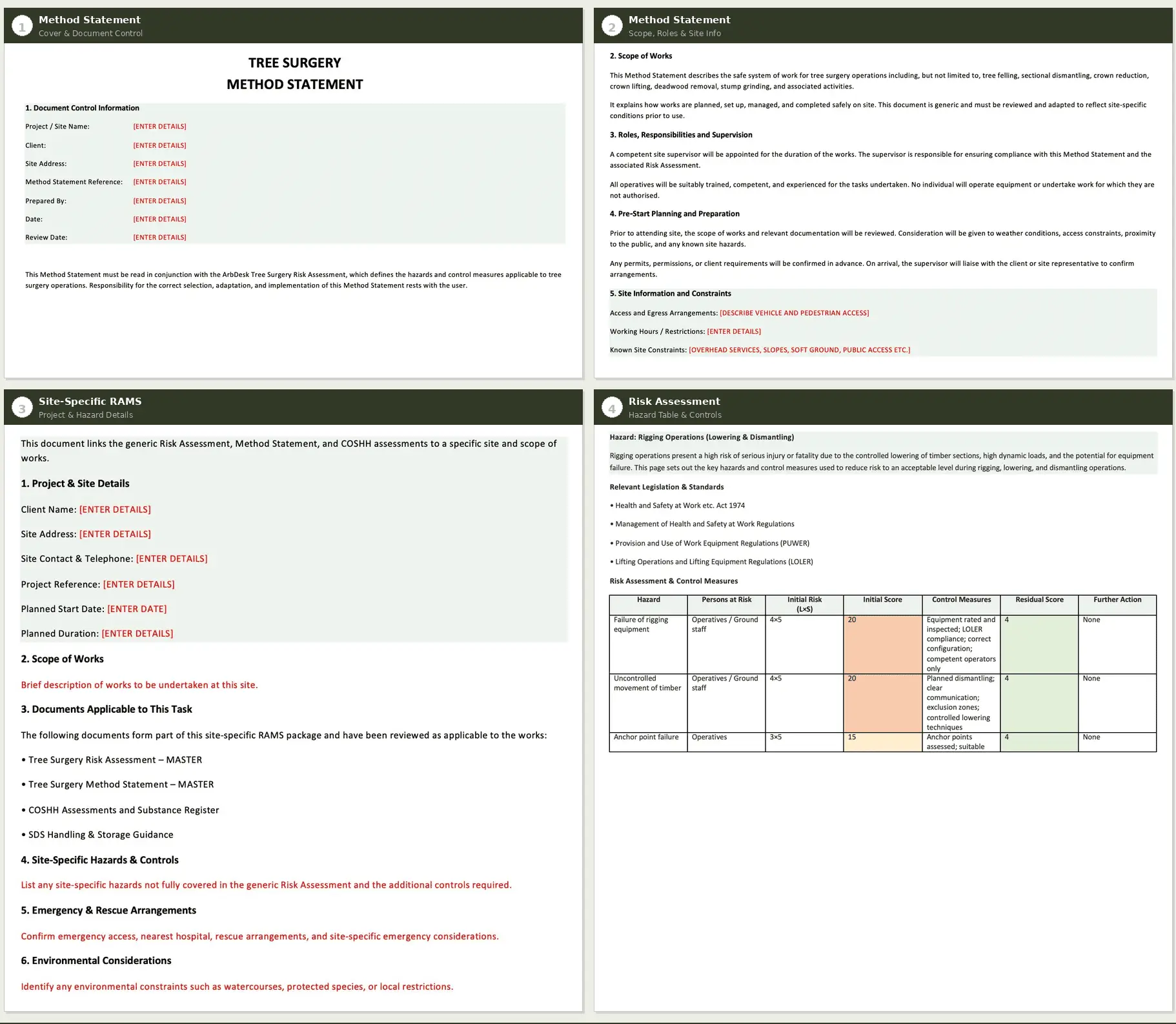
ArbDesk site-specific risk assessment — structured for UK commercial and council arborist submissions.
The legal basis for site-specific risk assessments
Requires “suitable and sufficient” risk assessments. A generic assessment that does not reflect the specific site does not meet this standard — site-specific information is what makes a risk assessment adequate.
Pre-construction information — including site-specific hazards — must be communicated to contractors before work begins. Site-specific risk assessments formalise this duty for arborist operations.
Work at height must be planned based on the actual conditions — including ground stability, overhead hazards and rescue access. The site-specific assessment is where these conditions are formally recorded.
Site-specific wildlife checks — particularly for nesting birds and bat roosts — must be carried out before work begins. The site-specific assessment is the appropriate place to document these checks.
Equipment suitability depends in part on the site conditions — ground stability for MEWPs, access for chippers, space for stump grinders. Site-specific conditions affect equipment safety decisions.
AFAG guidance requires site assessment before arboricultural operations begin. Site-specific risk assessments formalise this requirement and demonstrate compliance with industry best practice.
Written by a practising arborist
ArbDesk was built by Christian, a working arborist with direct experience submitting RAMS to principal contractors, local authorities and commercial clients across the UK. Every document in the ArbDesk system reflects what actually gets reviewed on commercial sites — not what a generic H&S template assumes reviewers want to see.
The system has been shaped by real submission feedback — what causes rejections, what gets accepted first time, and what commercial clients and councils actually check when they review arborist documentation.
“Proper system built around how arborist work actually runs. Not just a generic template.”
Site-specific risk assessment — frequently asked questions
Built for arborists working commercially
ArbDesk gives you a complete, structured RAMS system — risk assessments, method statements, COSHH, equipment records and operational safety documents built around what UK commercial clients actually expect to see.
Instant access · No app · No subscription · Fully editable documents
You may also find these useful