
Arborist Safety Documents Required UK
A complete overview of the safety documents UK arborists are required or expected to have in place — from RAMS and COSHH through to equipment records, site briefings and competence declarations.
The exact documents needed depend on the type of work, but for commercial and council jobs the expectations are structured, specific and non-negotiable.
Safety documents arborists need for UK commercial work
The table below covers the full range of documents arborists working on commercial sites in the UK are typically required or expected to produce. Documents marked as required are either a legal obligation or a near-universal contractual requirement. Those marked as commercial are expected on most principal contractor or council submissions.
| Document | Type | What it covers |
|---|---|---|
| Risk assessment | Required | Hazard identification, risk rating and control measures for all tree work activities |
| Method statement | Required | Step-by-step description of how the work will be carried out safely on site |
| Site-specific risk assessment | Required | Adapts the risk assessment to the specific location, access, public interface and hazards |
| COSHH assessment | Required | Assessment and control of hazardous substances including chainsaw fuel, bar oil and wood dust |
| Equipment pre-use checks (PUWER) | Required | Documented pre-use inspection of chainsaws, chippers, stump grinders and other machinery |
| Emergency arrangements | Required | First aid provision, nearest A&E, rescue plan for climbers and emergency access details |
| Competence declarations | Commercial | Confirmation of operator qualifications including relevant NPTC/City & Guilds units and first aid |
| Site safety briefing records | Commercial | Record of pre-work briefing covering the task, hazards, controls and emergency arrangements |
| Exclusion zone check records | Commercial | Documented checks that the work area is correctly set up and the exclusion zone is maintained |
| Near miss and incident reports | Commercial | Records of near misses and incidents on site — demonstrates active safety management |
| Equipment inspection logs | Commercial | Ongoing maintenance and inspection records for all plant and equipment used in the business |
| Training and competence records | Commercial | Internal training logs, certificates and refresher records for all operatives |
| LOLER records (where applicable) | Commercial | Thorough examination records for lifting equipment including MEWP and aerial rescue systems |
How arborist safety documents work together as a system
The documents listed above are not independent. On a well-run commercial job they form an interconnected system where each document references and supports the others. Understanding how they connect is what separates a professional submission from a collection of documents that happen to be in the same folder.
Risk assessment → Method statement
The risk assessment identifies the hazards and control measures. The method statement describes how those controls are applied in practice during the actual work sequence. They must be consistent with each other.
Method statement → Site-specific assessment
The method statement sets out the general approach. The site-specific assessment adapts it to the actual location — access, nearby hazards, public interface, emergency arrangements and client requirements.
COSHH → Equipment checks
COSHH assessments cover the substances used — fuel, oil, wood dust. Equipment pre-use checks cover the machinery that uses or creates those substances. Both are required before work begins.
Briefing records → Incident records
A site briefing record confirms that operatives were informed of the risks before work started. Near miss and incident records close the loop — demonstrating that safety is actively managed throughout the job.
What a complete arborist document system looks like
The ArbDesk system brings together RAMS, COSHH, equipment records and operational safety records in a consistent format — built around how commercial tree work is actually reviewed on site, not around generic H&S templates.
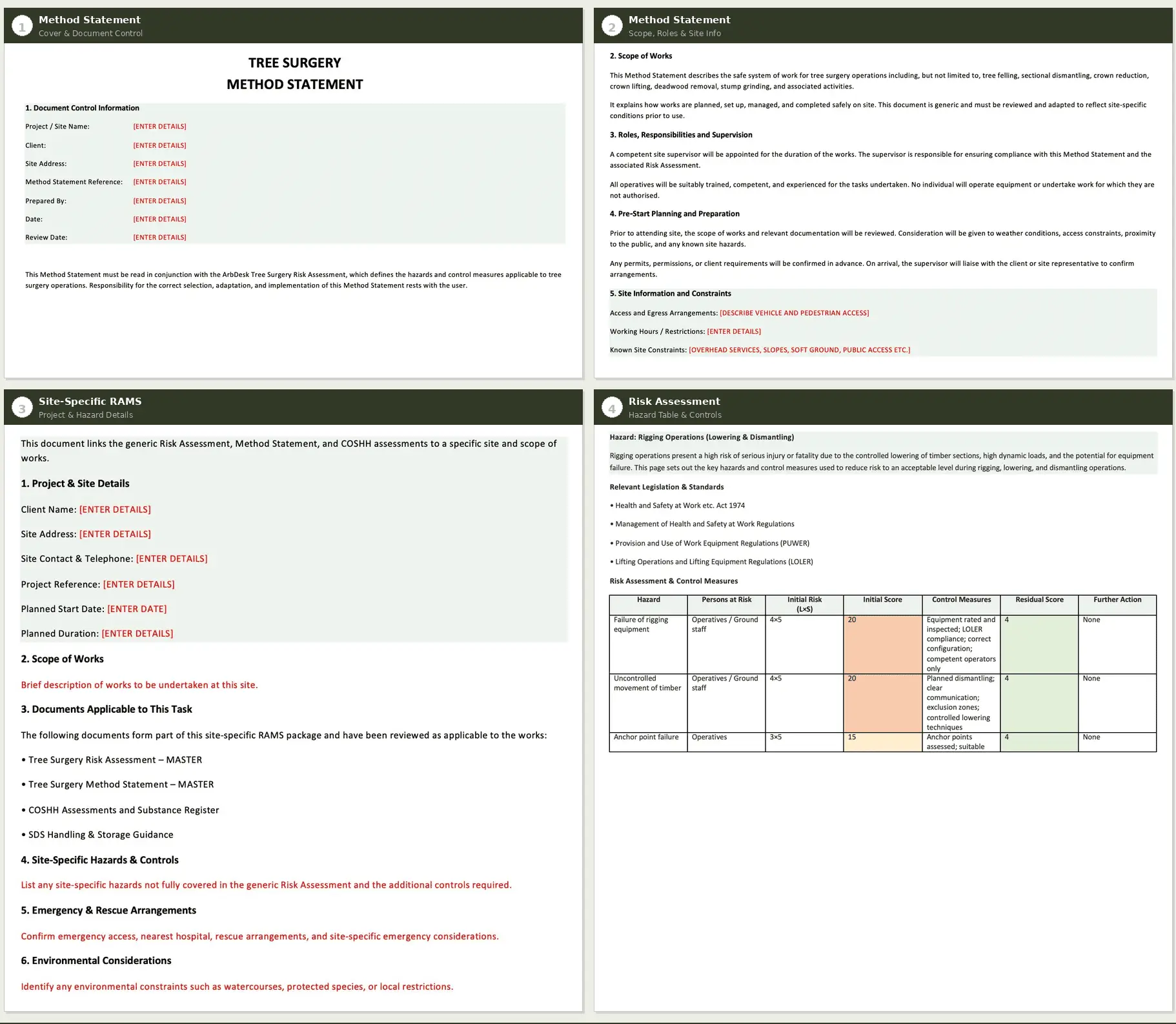
ArbDesk safety document system — RAMS, COSHH and supporting records structured for UK commercial arborist work.
The legislation behind arborist safety documentation
Each category of safety document required in commercial arborist work has a legal basis. Understanding which legislation applies — and what it requires — helps arborists ensure their documentation is not just present, but adequate.
Requires suitable and sufficient risk assessments for all work activities. For arborists, this covers every significant hazard in commercial tree work — chainsaw use, climbing, machinery, public interface and more.
Provision and Use of Work Equipment Regulations. Requires that equipment is suitable, maintained and operated by trained, competent persons. Pre-use checks are a key part of PUWER compliance for arborists.
Requires assessment and control of substances hazardous to health. For arborists this includes chainsaw fuel, bar oil, wood dust from processing, and any pesticides or herbicides applied on site.
Applies on construction-type sites where arborists work as subcontractors. Principal contractors require RAMS submissions before work begins — CDM sets the formal framework for this requirement.
Requires that all work at height is properly planned, supervised and carried out by competent persons. Documentation must reflect how aerial access is controlled throughout the operation.
Lifting Operations and Lifting Equipment Regulations. Applies where lifting equipment is used — including MEWPs and aerial rescue systems. Thorough examination records must be maintained and available.
How document requirements differ between domestic and commercial work
The safety documentation required for arborist work varies significantly depending on the type of client and site. Understanding the difference helps arborists plan their documentation system around the work they actually do.
Domestic and private work
- Basic risk assessment recommended but rarely formally required
- Method statement rarely requested by private clients
- COSHH assessment legally required for any substances used
- Equipment pre-use checks required under PUWER
- Emergency arrangements required — first aid, rescue plan
- Supporting records rarely requested but advisable
Commercial and council work
- Full RAMS submission required before site access is granted
- Site-specific assessment required for each location
- COSHH assessments required as part of submission
- Equipment records expected alongside RAMS
- Competence declarations and qualification copies required
- Site briefing records, exclusion zone checks and incident reports expected
Written by a practising arborist
ArbDesk was built by Christian, a working arborist with direct experience submitting safety documentation to principal contractors, local authorities and commercial clients across the UK. The system is not based on generic H&S templates — it reflects what commercial sites actually expect to see, and what causes documents to be rejected.
The complete document list above is based on real submission requirements from UK council contracts, principal contractor sites and estate management work — not on what the law technically requires in isolation, but on what the market actually expects in practice.
“Proper system built around how arborist work actually runs. Not just a generic template.”
Arborist safety documents — frequently asked questions
Get the complete arborist document system
ArbDesk gives you structured RAMS, COSHH assessments, equipment records and operational safety documents — all built for UK commercial tree work and ready to adapt for every job.
Instant access · No app · No subscription · Fully editable documents
You may also find these useful