
Commercial RAMS Submission for Tree Work UK
Submitting RAMS for commercial tree work is often the final step before a job is approved — and where many arborists run into delays, resubmissions or rejected work.
This guide covers what a commercial RAMS submission needs to include, how to format it for contractor review, the most common reasons submissions fail, and how to get accepted first time.
What is a RAMS submission for tree work?
A RAMS submission is the process of sending your Risk Assessment and Method Statement to a client, principal contractor or site manager for review and approval before work begins. For commercial tree work in the UK, this is a standard requirement on most council, estate, principal contractor and facilities management contracts — and access to site is typically not granted until the submission has been reviewed and approved.
The submission is not simply about having documents — it is about presenting them in a format that allows the reviewer to quickly understand the work, the risks and the control measures. A submission that is complete but poorly structured often gets delayed in the same way as one that is incomplete.
How to prepare a commercial RAMS submission for tree work
A complete commercial RAMS submission for tree work follows a consistent structure. The steps below reflect what principal contractors and local authorities expect to receive — in the order they typically review it.
Job description and scope
Open with a clear, specific description of the work being carried out — the species, location, tasks (felling, pruning, dismantling, stump grinding), and the client or principal contractor the work is being carried out for. Reviewers use this to quickly confirm the submission matches the job they are approving.
Hazard-based risk assessment
A structured risk assessment covering all significant hazards associated with the work — chainsaw use, climbing operations, machinery, public interface, manual handling and exclusion zones. Each hazard should include persons at risk, initial risk rating, control measures and residual risk. Generic hazard lists without meaningful controls are a common reason for rejection.
Method statement
A step-by-step description of how the work will actually be carried out — from site arrival through to completion. This should follow the real sequence of operations on site, not a generic description of tree work in general. It should reference how the control measures from the risk assessment are applied in practice.
Site-specific information
The section most commonly missing from generic submissions. This must include the specific site address, access arrangements, nearby hazards (roads, buildings, overhead lines, utilities), public interface and exclusion zone arrangements, weather and ground condition considerations, and any client or site-specific requirements.
Emergency arrangements
One of the most consistently checked elements of any RAMS submission. Must include the location of the nearest A&E hospital, first aid provision on site, the climber rescue plan, emergency contact details and how emergency services would access the site. These must be site-specific — a generic reference to “emergency services will be called” is not sufficient.
Competence and equipment
A record of operator qualifications (relevant NPTC/City & Guilds units), equipment to be used on site, and confirmation that equipment has been inspected in line with PUWER requirements. Many principal contractors also request copies of certificates and insurance documents at this stage.
Supporting documents
On higher-level commercial work, supporting records are often expected alongside the main RAMS document — COSHH assessments, equipment pre-use check sheets, site briefing records and exclusion zone check records. These demonstrate that safety is actively managed on site, not just documented beforehand.
What a complete commercial RAMS submission looks like
The ArbDesk system is structured specifically for commercial RAMS submissions — clear document layout, hazard-based risk scoring, step-by-step method statements and supporting records all formatted for fast contractor review.
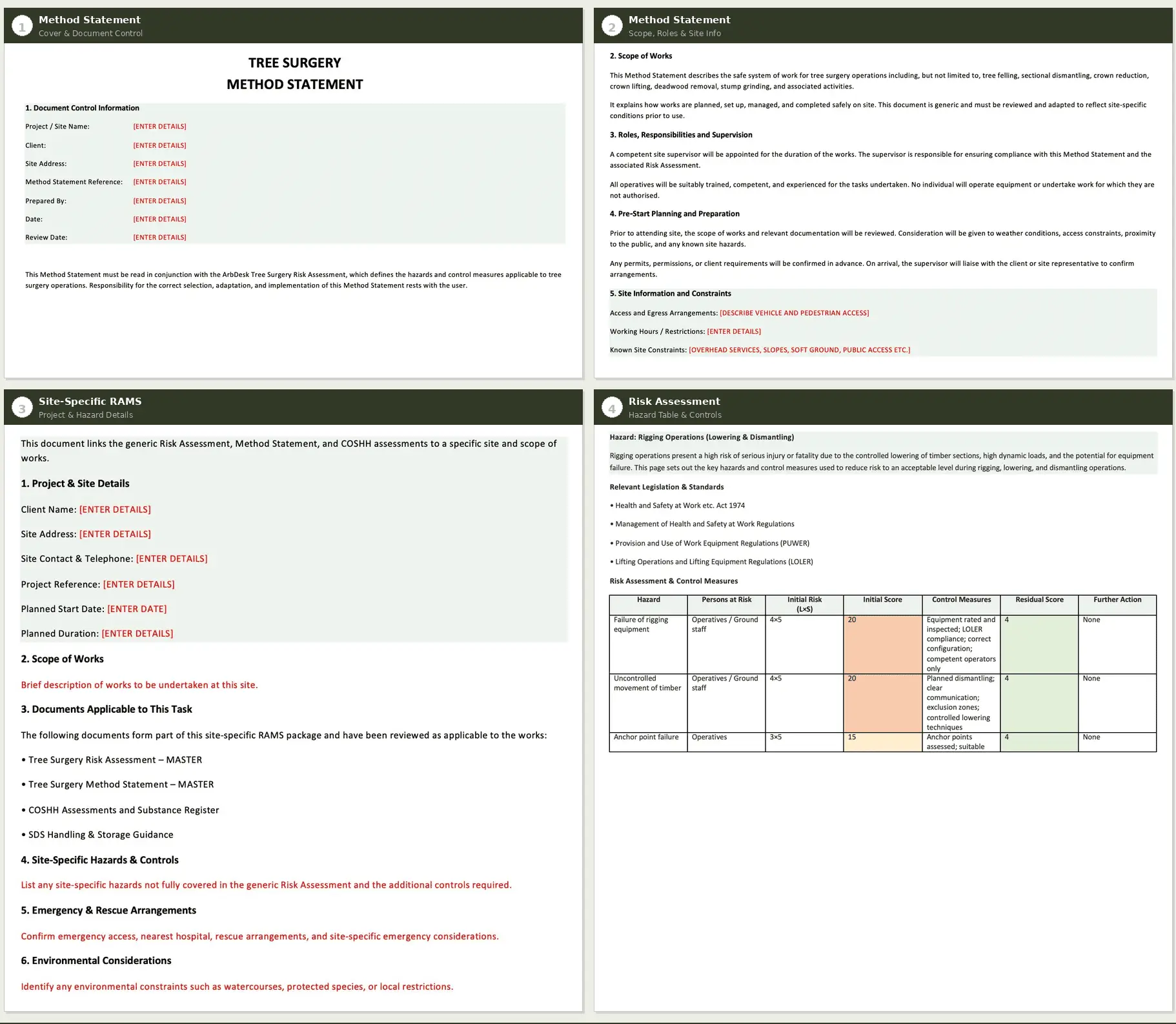
ArbDesk RAMS system — structured for commercial RAMS submissions to UK principal contractors and local authorities.
Common reasons commercial RAMS submissions get rejected
Most RAMS rejections are not about technical competence — they are about structure and completeness. The same arborist who is excellent on site can have their submission sent back repeatedly because of problems that have nothing to do with how they carry out the work.
Method statement too generic
Describes tree work in general rather than this specific job on this specific site. Reviewers identify this immediately and return the document for revision.
No site-specific detail
Risk assessments and method statements that read identically for every job signal that the actual site has not been considered. This is the single most common reason for rejection.
Emergency arrangements missing or vague
The nearest A&E location, first aid arrangements and climber rescue plan are almost universally checked. Leaving these blank or providing generic answers causes immediate rejection.
Public safety not addressed
How the public will be kept away from the work area, how pedestrians or site users will be managed, and how the exclusion zone will be maintained — often absent from generic submissions.
Hazards without meaningful controls
A list of hazards with vague controls (“use PPE”, “be careful”) does not demonstrate that the risks have been properly considered. Controls must be specific and realistic.
Missing supporting documents
On many commercial sites, COSHH assessments, equipment records and site briefing records are expected alongside the main RAMS. Submitting the RAMS alone is often insufficient.
The legislation behind commercial RAMS submissions
The requirement to submit RAMS before commercial tree work begins is grounded in several pieces of UK legislation. Understanding which laws apply helps arborists ensure their submission is not just present but legally adequate.
Requires suitable and sufficient risk assessments for all work activities. For arborists working commercially, this is the primary legislative basis for the risk assessment element of any RAMS submission.
Construction Design and Management Regulations apply when arborists work as subcontractors on construction-type sites. Principal contractors must receive method statement-style documentation before work begins — CDM is the formal framework for this requirement.
Requires that all work equipment is suitable, maintained and operated by trained, competent persons. RAMS submissions should reflect how PUWER compliance is maintained — including equipment checks and operator competence.
Requires assessment and control of substances hazardous to health — chainsaw fuel, bar oil, wood dust, pesticides. COSHH assessments are increasingly expected as part of commercial RAMS submissions rather than as separate documents.
Climbing and aerial operations must be planned, supervised and carried out by competent persons. The method statement within a RAMS submission should reflect how aerial access is managed and how a rescue would be carried out if required.
Arboriculture and Forestry Advisory Group guidance sets the industry standard for safe tree work operations. Commercial clients expect RAMS submissions to align with AFAG guidance — it is the benchmark reviewers use to assess competence.
Written by a practising arborist
The ArbDesk system was built by Christian, a working arborist with direct experience preparing and submitting RAMS to principal contractors, local authorities and commercial clients across the UK. The submission structure in ArbDesk reflects what commercial reviewers actually look for — not what a generic H&S template assumes they want to see.
Every element of the ArbDesk RAMS system has been shaped by real submission feedback — rejected documents, resubmission requests, and the specific questions that commercial clients and councils ask before granting site access. The result is a system built around what actually gets accepted, not just what technically satisfies the legal minimum.
“Proper system built around how arborist work actually runs. Not just a generic template.”
Commercial RAMS submission — frequently asked questions
Built for arborists submitting RAMS commercially
ArbDesk gives you a complete, structured RAMS submission system — risk assessments, method statements, COSHH, supporting records and editable Word documents built around what commercial reviewers actually expect to see.
Instant access · No app · No subscription · Fully editable documents
You may also find these useful