
Near Miss Reporting for Arborists UK
Near miss reporting helps arborists record events that could have caused injury, damage or disruption — even where no one was hurt. For commercial tree work, a documented reporting system shows that site safety is actively monitored, not just planned before the job starts.
This guide covers what counts as a near miss in tree surgery, what a report should include, the legal framework behind near miss reporting, and how to build a system that satisfies commercial site expectations.
What is a near miss in arborist work?
A near miss is an unplanned event that did not cause injury or damage, but had the potential to do so. In tree surgery, near misses occur regularly across climbing, chainsaw operations, rigging, chipper use, vehicle movement and public interaction — and the vast majority go unrecorded.
Recording near misses is how professional businesses identify weaknesses in planning, communication, equipment, site setup or working methods before a more serious incident occurs. A near miss is not a failure — it is valuable information about what nearly went wrong and why, which can be used to prevent the same situation from becoming an accident.
What counts as a near miss in tree surgery?
Near misses in arborist work fall across several categories — equipment, public interface, communication, ground conditions and environmental factors. The following are common examples that should be recorded whenever they occur.
Falling debris outside the drop zone
A branch or section lands outside the intended exclusion zone but causes no injury or damage. Should trigger a review of exclusion zone size and rigging controls.
Public access breach
A member of the public enters or approaches the work area during operations — including through gaps in barriers, around signs, or past an unattended access point.
Equipment defect found before use
A pre-use check identifies a defect that could have caused injury if the equipment had been used — chain brake failure, worn harness stitching, cracked chipper guard.
Vehicle or machinery movement risk
A vehicle, trailer or machinery movement creates a risk to operatives, pedestrians or site users — reversing without a banksman, a trailer coupling failure, or equipment rolling on a slope.
Communication failure
Ground staff and a climber misunderstand instructions, creating a risk during cutting, lowering or rigging operations — a misheard signal, a blocked line of sight, or an unexpected action.
Slip, trip or ground hazard
An operative slips, trips or nearly falls due to uneven ground, brash, wet timber or poor access — particularly relevant during chipper feed, timber handling and site clearance.
Chainsaw kickback or unexpected movement
A chainsaw kicks back, binds unexpectedly or moves in an unintended direction during cutting — even if no contact is made, this is a significant near miss requiring investigation.
Overhead line proximity
A branch, section or equipment comes closer than the safe working distance to an overhead line — including during felling, rigging or machinery positioning.
What a near miss report should include
A near miss report should be simple enough to complete quickly on site but detailed enough to be useful when reviewed later. The following elements should be included in every near miss record.
Essential information
- Date, time and location of the event
- Names of people involved or potentially affected
- Clear description of what happened
- What the potential consequence could have been
- Immediate action taken at the time
- Corrective action required going forward
- Person responsible for follow-up action
- Confirmation that the issue has been closed out
What to do after recording
- Review the report against the relevant RAMS and method statement
- Identify whether the control measures in place were adequate
- Decide whether RAMS, exclusion zones or briefings need updating
- Brief the team on what happened and what changes are being made
- Retain the record — it is evidence of active safety management
- Consider whether the event meets RIDDOR reporting thresholds
- File alongside site briefing records and equipment check records
The legal basis for near miss reporting in arborist work
Near miss reporting is not just good practice — it sits within a legal framework that requires arborists to manage risks actively and learn from events that could cause harm. The following legislation is relevant:
Requires risk assessments to be reviewed when there is reason to believe they are no longer valid. A near miss is a clear signal that something in the risk assessment, method statement or site controls may need updating.
Reporting of Injuries, Diseases and Dangerous Occurrences Regulations. While most near misses are below the RIDDOR threshold, certain dangerous occurrences — including structural collapses, electrical incidents and falls from height — must be reported to the HSE regardless of whether injury occurred.
The overarching duty to ensure health, safety and welfare. A near miss reporting system is part of demonstrating that this duty is being actively discharged — not just documented at the start of a job.
On principal contractor sites, arborists working as subcontractors may be required to report near misses to the principal contractor’s site H&S team. CDM requires principal contractors to maintain site safety records which include near miss and incident data.
HSE actively encourages near miss reporting as a proactive safety management tool. Businesses with active near miss reporting systems are less likely to face enforcement action because they demonstrate a genuine commitment to continuous improvement.
Arboriculture and Forestry Advisory Group guidance recognises near miss reporting as part of a professional safety management system. Commercial clients use AFAG-aligned systems as the benchmark for assessing contractor competence.
Why near miss reporting matters for commercial tree work
Commercial clients, councils and principal contractors want evidence that safety is managed throughout the job — not just planned before arrival. A near miss reporting system provides that evidence by showing that unsafe events are identified, recorded, acted on and used to improve how the work is controlled.
Demonstrates active safety management
A business that records near misses is demonstrably managing safety in practice, not just on paper. This is exactly what commercial clients and HSE inspectors look for.
Strengthens RAMS submissions
Having a near miss reporting system in place — and being able to show records — is a mark of professional operational management that distinguishes serious arborist businesses from others.
Reduces serious incident risk
Near misses are early warnings. Addressing the root cause of a near miss — exclusion zone size, communication protocol, equipment condition — prevents the same situation becoming an accident.
Provides legal protection
If a serious incident does occur, documented near miss records demonstrate that safety was being actively managed and that lessons were being learned — not ignored.
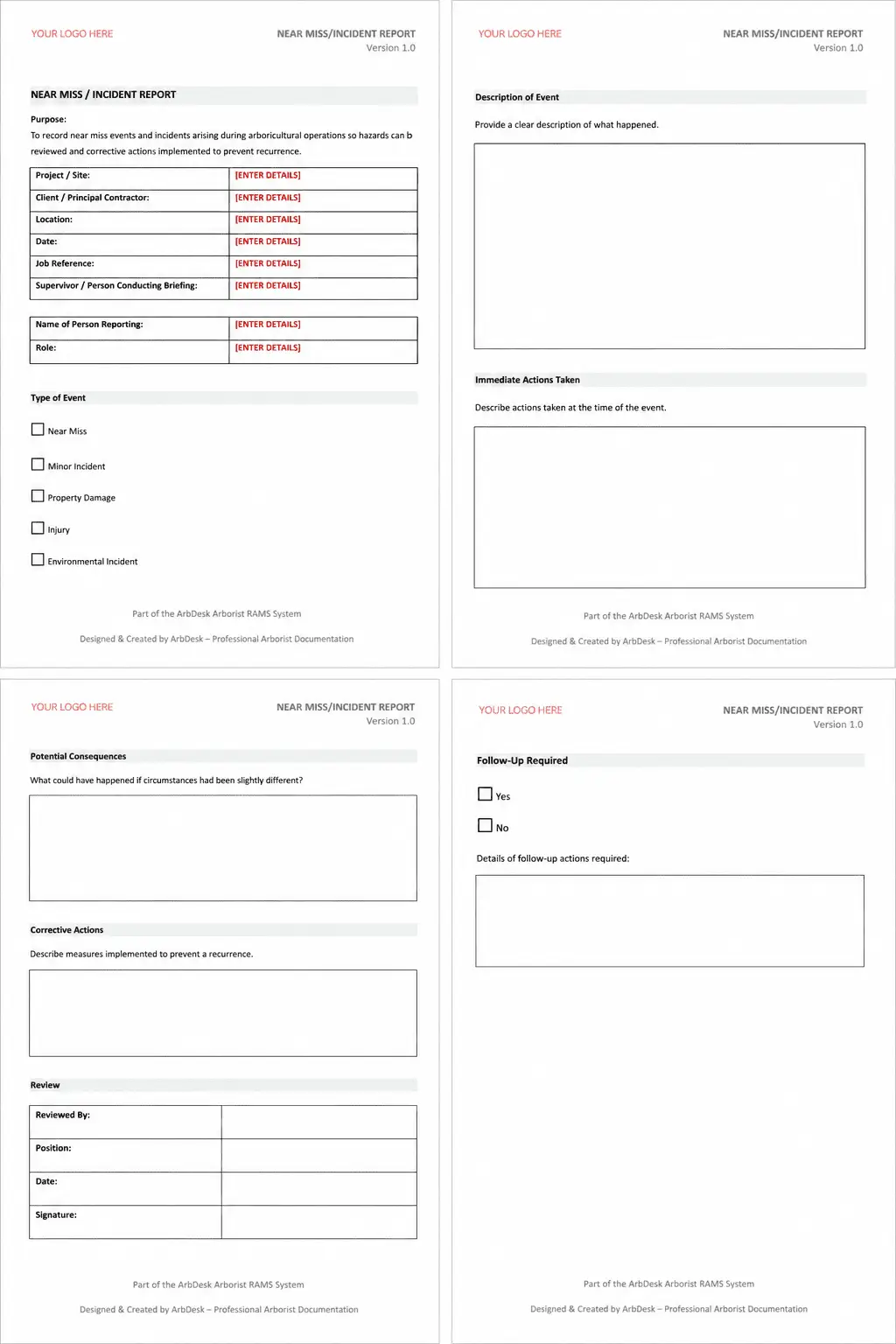
ArbDesk site safety records — near miss/incident reporting, structured for UK commercial arborist work. (included in Pro Pack)
Written by a practising arborist
The ArbDesk near miss and incident reporting system was built by Christian, a working arborist with direct experience of what commercial sites expect when they review your safety management records. The report format in ArbDesk is structured to be quick to complete on site without being so simple that it fails to capture the information needed for genuine investigation and improvement.
Near miss records in ArbDesk are designed to sit alongside site briefing records, equipment pre-use checks and RAMS documents — forming a complete, coherent safety management record for every commercial job.
“Proper system built around how arborist work actually runs. Not just a generic template.”
Near miss reporting — frequently asked questions
Site records that support commercial RAMS
The ArbDesk Pro Pack includes the full RAMS system plus near miss and incident reporting, daily site briefing records, work area checks and equipment pre-use checks — everything needed for a complete commercial site safety record.
Instant access · No app · No subscription · Fully editable documents
You may also find these useful