
Chainsaw Risk Assessment (UK Arborists)
A chainsaw risk assessment should do more than list generic hazards. For UK arborists working on real sites, it needs to reflect how ground-based chainsaw work is actually carried out, what control measures are in place, and how risk is reduced to an acceptable level.
This page explains what a professional chainsaw risk assessment should include, why generic templates often fall short, and how ArbDesk structures RAMS for commercial tree work.
What is a chainsaw risk assessment?
A chainsaw risk assessment is a structured record of the hazards involved in chainsaw use, the people at risk, and the control measures used to reduce those risks. For arborists, this usually forms part of a wider RAMS document and should be adapted to the specific work being carried out.
For ground-based chainsaw operations, that means considering the saw itself, the working area, manual handling, footing, public interface, fuel handling, and the competence of the operator.
What should a chainsaw risk assessment include?
A professional chainsaw risk assessment for UK tree work should usually include:
- The specific task being carried out
- The hazards associated with chainsaw use
- Who may be affected
- Initial risk rating
- Practical control measures
- Residual risk after controls are applied
- Any further actions required
- Relevant legislation or guidance
- Site-specific considerations
For commercial work, this should not be a loose generic checklist. It should be structured clearly enough for a contractor, principal contractor or client to review quickly and understand how the work will be controlled on site.
Relevant UK guidance and site expectations
For arborists in the UK, chainsaw risk assessments are usually expected to align with practical site controls as well as recognised legal duties and guidance. Depending on the work, that may include PUWER, the Management of Health and Safety at Work Regulations, AFAG guidance, manufacturer instructions, and site-specific requirements set by the client or contractor.
On commercial sites, it is also common for RAMS submissions to be reviewed alongside supporting documents such as equipment checks, site briefings and exclusion zone controls. That is one reason why a chainsaw risk assessment often needs to sit within a wider structured system rather than as a standalone template.
Why generic chainsaw risk assessment templates often fail
Many free or generic templates look acceptable at first glance, but they often fail in practice because they are too vague, too broad, or not properly structured for commercial review.
- Hazards listed without meaningful control measures
- No clear risk scoring method
- No site-specific detail
- No link to the wider RAMS structure
- No supporting records or evidence of implementation
That usually leads to paperwork that looks like a form has been filled in rather than a system that reflects how the work will actually be managed.
Example of a structured chainsaw risk assessment
This is the kind of structured, hazard-based format used in ArbDesk RAMS for commercial tree work. It shows clear hazard identification, initial and residual risk scoring, and practical control measures linked to the task.
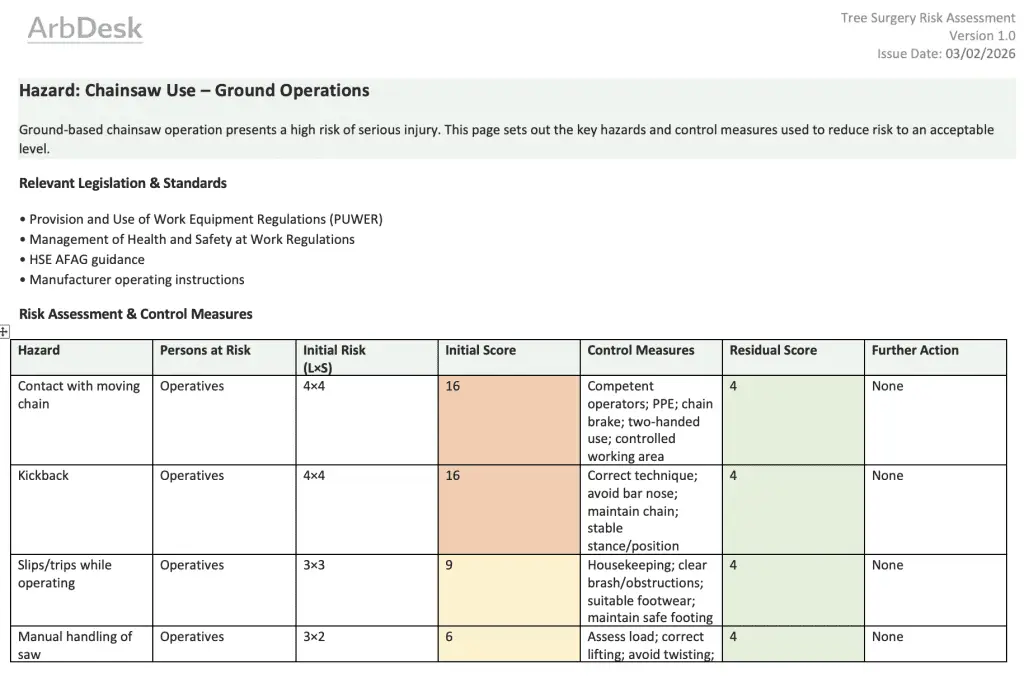
Example of a structured chainsaw risk assessment page used within the ArbDesk Tree Surgery RAMS system.
Why structure matters on commercial sites
On many commercial sites, RAMS are reviewed quickly. The paperwork needs to be clear enough for someone else to understand the task, the hazards, the controls, and the overall approach without digging through vague notes or generic wording.
That is why structure matters. A strong chainsaw risk assessment should not just exist to tick a box. It should help show that the work has been properly considered, the risks are understood, and the control measures are realistic for the site and job in question.
This is also where many arborists realise that RAMS alone are not always enough. On higher-level commercial work, supporting records are often expected alongside the assessment itself.
Need a complete arborist RAMS system?
ArbDesk is designed for arborists who need more than a generic template. The system includes structured RAMS, supporting safety records, editable Word documents and a format built around how commercial tree work is actually reviewed on site.
If you want to see the structure before buying, download the free sample below.
You may also find these useful: Tree Surgery RAMS Template, COSHH Assessment for Arborists, and Site-Specific Risk Assessment for Tree Work.